

60–70% of AI initiatives start at the pilot stage, but the real opportunity lies in what comes next: scaling them into meaningful, enterprise-wide impact.
And that is exactly where the shift begins.
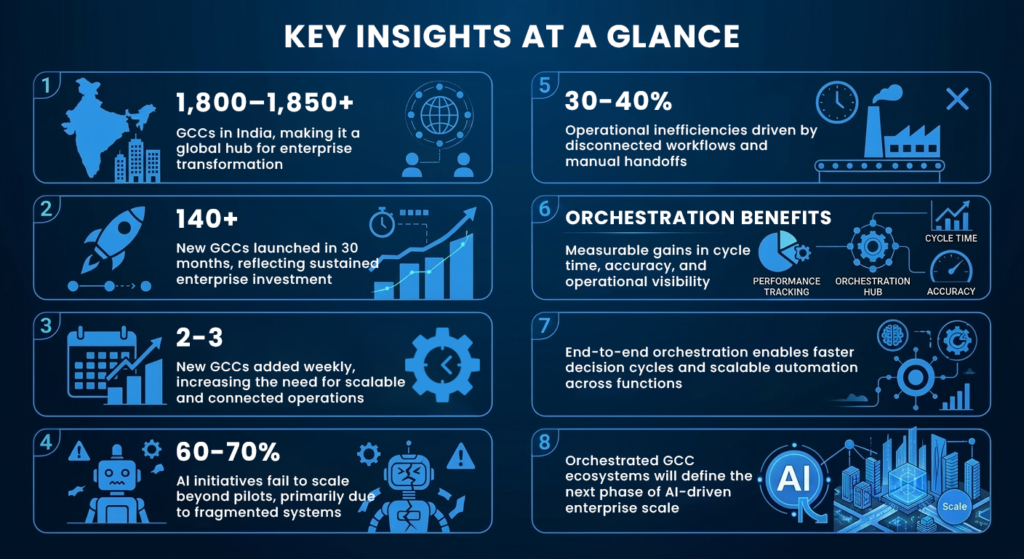
India alone is now home to over 1,800–1,850 Global Capability Centers, making it one of the most dynamic enterprise ecosystems globally. The pace is only accelerating with 140+ new GCCs launched in the 30 months leading up to October 2025, and 2–3 new centers being added every week.
That’s not just growth. That’s momentum at scale.
And with this momentum comes a new expectation not just to adopt AI and automation, but to make them truly work across the organization. AI is already in place. Automation is already running across functions.
Now, the real opportunity lies in bringing everything together, scaling these capabilities in a way that feels seamless, connected, and impactful.
This is where AI-driven GCC operations begin to evolve, moving beyond isolated automation towards integrated systems that collaborate, adapt in real-time, and scale with the business.
Why Organizations Are Doubling Down on GCCs
Organizations are repositioning Global Capability Centers from cost centers to strategic engines driving innovation and business value at scale.
The role of Global Capability Centers has evolved significantly.
Today’s GCCs are designed to:
- Drive enterprise-wide innovation
- Accelerate AI and automation adoption
- Enable global operations with local agility
- Deliver continuous business value
This shift is also accelerating the adoption of GCC AI automation, as organizations move to embed intelligence directly into their operational models.
GCCs no longer support functions. They are where transformation happens.
Growth Is Happening. But Is Scale Keeping Up?
Most GCCs today already have a lot in place: AI models are live, RPA bots are handling operations, and BPM tools are managing workflows.
On the surface, everything looks ready.
When you take a step back, a different reality begins to unfold.
- Systems don’t always talk to each other.
- Processes pause between tools.
- Teams often step in to bridge the gaps.
- And insights, while available, aren’t always real-time.
So yes, progress is visible, but scaling it consistently is where the real opportunity lies.
Industry trends show that 60–70% of AI initiatives don’t move beyond the pilot stage, not because the technology isn’t working, but because everything around it isn’t fully connected.
The Real Challenge: Fragmentation
Without orchestration, operations often remain partially connected:
- Automation works, but not always in sync
- Decision-making takes longer than expected
- Teams step in to bridge workflow gaps
- AI investments don’t always reach their full potential
Over time, this creates unnecessary complexity.
And that’s where the real opportunity lies, simplifying operations to unlock true scale.
Connecting What Matters for Scale
So what does it actually take to scale AI effectively?
It starts with a simple shift, not in adding more tools, but in bringing everything together so it works as one connected system.
When systems, processes, and intelligence are aligned, things begin to change in a very real way. Workflows move more smoothly. Decisions happen faster. And teams spend less time managing gaps and more time driving outcomes.
Instead of automation working in parts, it starts working as a whole.
This allows AI-driven GCC operations to unify efforts and scale consistently across functions and regions.
It’s not just about automating processes, it’s about connecting them to deliver real, measurable impact.
Orchestration: The Missing Link in Scaling AI
So how do organizations actually make this shift happen?
Orchestration changes the equation.
Think of it as the layer that brings everything together: systems, processes, AI models, and human inputs into one connected, seamless flow. Instead of tools operating in isolation, everything starts working in sync.
And that’s when the real difference becomes visible.
- Processes move without interruptions.
- Decisions happen in real time.
- Automation scales without adding complexity.
This is what helps GCC AI automation grow beyond individual use cases and start creating real value across the entire enterprise.
Orchestration doesn’t replace your technology stack. It brings everything together and unlocks its full potential.
Scaling GCC AI Automation: What Changes at Enterprise Level
This is where the real transformation begins.
Scaling is not about doing more automation; it’s about making automation work together as a connected system. As orchestration comes into play, automation evolves from isolated efforts into a unified approach that continuously delivers value.
Let’s look at what truly changes:
1. From isolated tasks to connected workflows
Instead of multiple tools handling separate steps, processes become seamless, end-to-end journeys flowing without interruptions or manual stitching.
Impact: Faster execution, reduced delays, and more consistent outcomes
2. From insights to real-time action
AI insights move beyond static dashboards and become embedded within workflows, triggering actions, guiding decisions, and adapting in real time.
Impact: Greater accuracy and faster, more informed decision-making
3. From operational effort to strategic focus
Teams shift from managing process gaps to improving outcomes, focusing on optimization, innovation, and value creation.
Impact: Higher productivity and more meaningful work
4. From pilot success to enterprise-wide scale
Automation expands beyond individual use cases into scalable, repeatable frameworks across functions and geographies.
Impact: Stronger ROI and sustainable transformation
This is the real shift: From automation that works to automation that scales.
Human Intelligence + AI Efficiency: The Winning Formula
As organizations scale automation, a new operating model is emerging, one where AI and human intelligence work together seamlessly to drive better outcomes.
With orchestration:
- Repetitive work is reduced, allowing teams to focus on higher-value tasks
- Decision-making becomes faster, more informed, and data-driven
- Collaboration across systems and teams becomes more connected and efficient
AI drives speed and efficiency. Humans drive context, judgment, and innovation.
The Future of AI-driven GCC Operations
As GCCs continue to evolve,one trend is becoming increasingly clear: success will depend not just on capability, but on connectivity.
Growth will no longer be defined by how many tools are deployed, but by how effectively systems, data, and decisions come together within a unified operational model. This shift is already taking shape through AI-driven GCC operations, where intelligence is embedded across workflows and decision layers.
At the same time, the GCC automation as a service market is evolving rapidly, with organizations prioritizing platforms that enable integration, scalability, and real-time orchestration.
Looking ahead:
- Every process will be data-driven
- Every decision will be real-time
- Every system will be interconnected
Orchestrated GCC ecosystems will define the next wave of enterprise scale.
Navigating the GCC Automation as a Service Market
As the GCC automation as a service market continues to evolve, organizations are increasingly prioritizing platforms that enable integration, scalability, and real-time execution.
While the opportunity is significant, the focus is shifting from adopting multiple tools to enabling them to work together seamlessly within a unified ecosystem.
Making Orchestration Work in the Real World
The idea sounds simple, but making it work in real-world operations is where it truly matters.
For many GCCs, the challenge isn’t understanding orchestration. It’s making it work across systems, teams, and workflows without adding more complexity.
That’s where the right approach makes all the difference.
At Aptimeta, the focus is on enabling this shift in a way that feels seamless and scalable:
- Connecting systems and workflows into a unified flow
- Integrating AI directly into real-time operations
- Reducing fragmentation across processes
- Building automation ecosystems that scale with the business
Connected intelligence that drives measurable business impact.
Final Thought
AI is embedded across operations. Automation is driving execution at scale.
But scale?
It comes down to one thing: how well everything works together.
Because in a rapidly expanding GCC ecosystem, success won’t be defined by how many tools you adopt, but by how effectively you orchestrate them.