
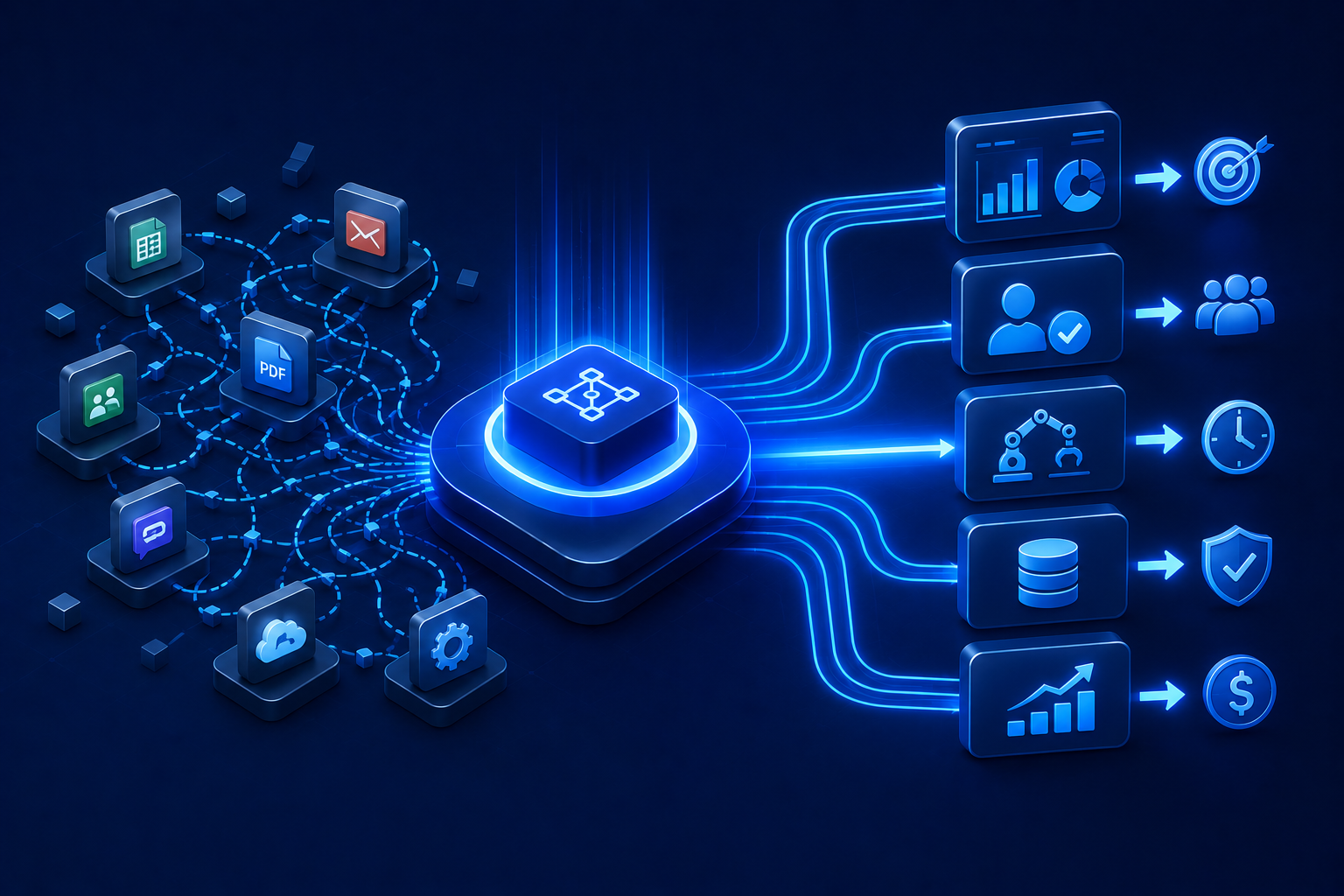
Most enterprises today are not short of automation tools. An RPA platform handles repetitive data tasks. An IDP solution processes incoming invoices. A BPM tool manages approval flows. A rules engine handles compliance checks. On paper, the automation stack looks impressive.
In practice, it often looks more like a patchwork. Each tool does its job, but the tools do not speak to each other. A process that spans three systems requires manual handoffs between them. When something goes wrong mid-flow, there is no single place to see it, diagnose it, or fix it. Scaling the automation means scaling the complexity – and the integration debt compounds with every new tool added.
This is the problem that workflow orchestration solves. It is the coordination layer that connects every automation tool, every system, every human task, and every data flow into a single, coherent, managed process. Understanding what orchestration is – and why it is different from automation – is essential for any enterprise serious about scaling its digital transformation.
What Is Workflow Orchestration?
Workflow orchestration is the technology that sequences, routes, and manages work across multiple systems, tools, people, and automation technologies – coordinating them into a coherent, end-to-end flow.
Where automation executes a task, orchestration manages the relationship between tasks. It determines what runs next, under what conditions, with what data, and what should happen when something does not go as expected. Orchestration is the conductor; the automation tools are the instruments.
An orchestration platform handles questions that individual automation tools cannot answer on their own:
- Which system should handle this next step – the RPA bot, the human reviewer, or the AI decision engine?
- What data does the next step need, and where does it come from?
- If the approval step takes longer than the SLA, who gets escalated to?
- If the IDP step fails to extract a field with sufficient confidence, what is the fallback path?
- How is the whole process performing across thousands of concurrent instances?
These are orchestration concerns. Answering them requires a platform that can see across the entire process and coordinate all its components in real time.
Automation vs Orchestration: A Critical Distinction
The most important conceptual distinction in enterprise automation is the difference between automating a task and orchestrating a process. Confusing the two is one of the primary reasons automation programmes stall or fail to scale.
Automation is task-level. An RPA bot logs into a portal and extracts data. An IDP system reads an invoice and outputs structured fields. A rules engine evaluates a condition and returns a result. Each of these is a discrete automated action.
Orchestration is process-level. It decides that the IDP system should run first, that its output should be passed to the rules engine for validation, that the validated data should trigger the RPA bot to update the ERP, and that the whole sequence should complete within a defined SLA – with specific escalation logic if it does not.
Without orchestration, the automation tools in an enterprise operate as independent units. They may each work well individually, but there is no intelligence coordinating them into a process. The gaps between them – the handoffs, the exception paths, the data routing – are filled by people, email, and manual workarounds.
Technology leaders at organisations that have attempted large-scale automation without orchestration consistently report the same findings: individual tools perform well, but the end-to-end process remains slow, opaque, and dependent on human intervention to hold it together.
Why Point Solutions Fail at Scale
A point solution is a tool built to solve one specific problem. RPA is a point solution for task automation. IDP is a point solution for document processing. Standalone approval workflow tools are point solutions for routing. Each delivers value in its domain.
The limitations of point solutions become acute when an organisation tries to build cross-functional, end-to-end automation. The core problems are structural:
- No cross-system visibility: Each tool has its own dashboard and reporting. There is no unified view of a process that spans multiple tools. Diagnosing where a process instance is stuck requires checking multiple systems.
- Integration debt: Every new tool added to the stack requires integration with every other tool it needs to communicate with. In a five-tool stack, that can mean ten integration points, each of which needs to be built, maintained, and updated when any tool changes.
- Brittle exception handling: When an exception occurs mid-process, individual tools typically cannot see the upstream or downstream context. Exceptions either fail silently or surface in an error log that no one is monitoring.
- SLA blindness: Point solutions do not manage SLAs across process steps that span multiple tools. There is no mechanism to detect that a cross-system process is running late and trigger an escalation.
- Governance gaps: Compliance and audit requirements demand a complete record of what happened in a process. In a multi-tool stack without orchestration, assembling that record requires pulling logs from multiple systems.
Orchestration eliminates these problems by sitting above the individual tools and providing unified coordination, visibility, and governance across the entire process.
Core Capabilities of a Workflow Orchestration Platform
A mature workflow orchestration platform provides the following capabilities that no individual automation tool can deliver on its own:
- Process routing: Intelligently routes work to the right resource at each step – a human approver, an RPA bot, an AI agent, or an external system – based on data, business rules, and current workload.
- Cross-system coordination: Manages the data flow and sequencing between tools and systems that have no native connection to each other, eliminating manual handoffs through Web Flow Automation.
- Exception handling: Detects when a step fails or produces an unexpected result and routes the exception through a defined resolution path – whether that is a human review queue, an AI resolution step, or an escalation to a manager.
- SLA management and alerting: Monitors every process instance against defined time targets and triggers alerts or escalations before deadlines are missed using Business Process Automation.
- Monitoring and observability: Provides a real-time view of all running process instances – where they are, how long they have taken at each step, and where bottlenecks are forming.
- Audit trail: Records every action, decision, and data change across the full process, satisfying compliance and audit requirements without requiring manual log consolidation.
Where Orchestration Is Essential
Workflow orchestration is particularly valuable for complex, cross-functional business processes where work must flow through multiple systems and teams. The use cases where orchestration is most essential include:
Order-to-Cash
From order receipt through fulfilment, invoicing, and payment collection, Order-to-Cash spans sales, operations, finance, and logistics. Each step depends on the prior one, and exceptions are common. Orchestration ensures the process flows end-to-end with visibility and control at every stage.
Procure-to-Pay
Vendor onboarding, purchase requisition, approval, goods receipt, invoice processing, and payment span procurement, finance, and operations. Without orchestration, the process is held together by email and manual tracking.
Employee Lifecycle
From hire to retire, the employee lifecycle involves HR, IT, finance, payroll, and managers. Orchestration ensures that each transition – onboarding, role change, offboarding – triggers the right actions in the right systems at the right time.
Patient Journey in Healthcare
From referral to discharge, the patient journey involves scheduling, clinical documentation, lab processing, care planning, billing, and follow-up. Orchestration coordinates these steps across systems that were often not designed to work together.
How Aptimeta’s Orchestration Layer Ties It All Together
Aptimeta‘s platform is built around a unified orchestration engine that connects BPM, RPA, IDP, and Agentic AI into a single, coordinated automation fabric.
When a document arrives and is processed by IDP, the extracted data does not wait to be manually passed to the next step. The orchestration layer detects the output, applies business rules, and triggers the appropriate next action – whether that is an RPA bot updating the ERP, a BPM-governed approval flow, or an Agentic AI step handling a complex decision.
This architecture means that every automation component in the Aptimeta platform operates within a governed, visible, and manageable process context. There are no gaps between tools, no manual handoffs, no exception queues that fall through the cracks. The orchestration layer provides the coherence that transforms a collection of automation tools into a genuinely intelligent business process platform.
For enterprises that have accumulated multiple automation tools and are finding that the sum is less than its parts, orchestration is the answer. It does not require replacing what you have built. It provides the coordination layer that makes your existing investments work together – and makes scaling genuinely possible.