
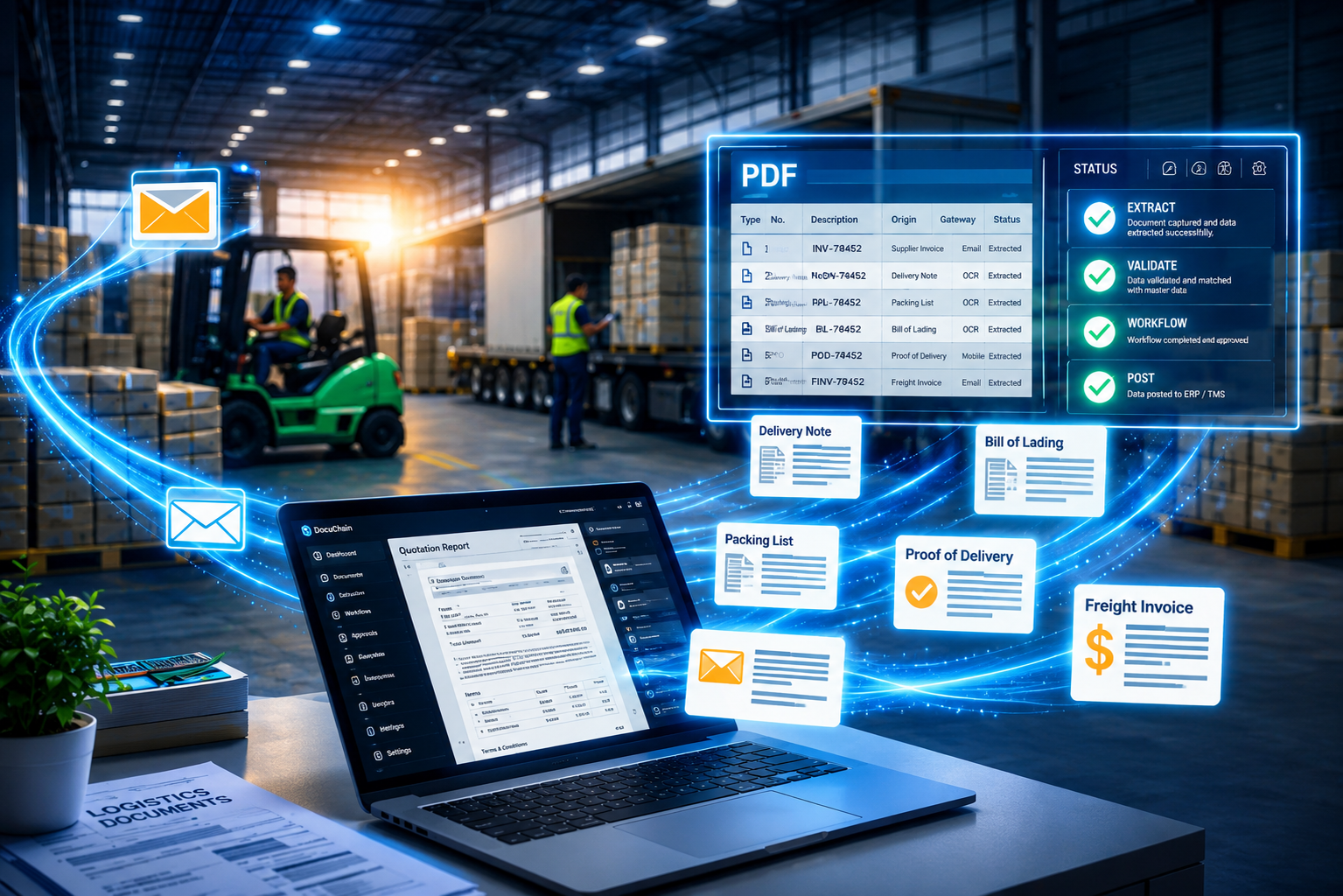
A shipment’s documentary journey does not end when it leaves the warehouse, and it does not end when it reaches its destination. From a business process perspective, the journey ends only when the shipment has been delivered, invoiced, matched, and paid.
That means the full process spans warehouse dispatch, transit documentation, proof of delivery, invoicing, and payment—often across several systems and multiple organisations.
Most logistics operations automate these stages independently. A Warehouse Management System manages dispatch, a Transportation Management System manages transit, and a finance platform manages invoicing. Manual handoffs then connect these otherwise separate systems.
Each system may perform its individual function effectively. The problem lies between them.
These handoffs create opportunities for delays, data-entry errors, documentation mismatches, and invoice disputes.
Full-chain orchestration takes a different approach. Instead of treating dispatch, transit, delivery confirmation, and invoicing as separate processes, it connects them into one governed workflow where the completion of one stage automatically triggers the next.
Where the Logistics Chain Breaks
One of the most common break points occurs between proof of delivery and invoicing.
A shipment may arrive successfully and the delivery may be confirmed, but if that confirmation does not automatically reach the finance system, someone must manually identify the completed delivery, locate the proof of delivery document, and initiate invoice generation.
This creates unnecessary delays between physical delivery and financial closure.
Another frequent problem occurs when dispatch information does not match the information eventually used for invoicing.
For example, a warehouse system may record one quantity while a manually re-entered quantity is used by the billing system. The resulting discrepancy can trigger a customer dispute that requires teams to investigate records across multiple disconnected systems.
What Full-Chain Orchestration Connects
End-to-end orchestration connects warehouse dispatch records, transit and customs documentation, proof of delivery, and invoicing within a single workflow.
Each stage automatically passes the relevant information to the next stage rather than relying on employees to recognise that an activity has been completed and manually initiate the following step.
- Dispatch quantities flow directly into transit documentation, eliminating unnecessary re-entry.
- Proof of delivery automatically triggers invoice generation once delivery is confirmed.
- A single traceable record connects dispatch, transit, delivery, and invoicing for every shipment.
- Discrepancies are identified when records first conflict rather than weeks later during an invoice dispute.
Connecting Physical Delivery to Financial Closure
The objective is not simply to automate individual logistics activities.
The real opportunity is to connect the physical movement of goods with the financial processes that follow.
When dispatch information, shipment documentation, delivery confirmation, and billing operate as one connected process, organisations gain greater control over the complete order-to-cash journey.
Delivery confirmation can immediately trigger downstream financial processes. Shipment data can flow directly into billing without manual re-entry. And every stage can remain connected through a single operational record.
Reducing Freight Invoicing Disputes
Freight invoice disputes are often expensive to resolve because the evidence required to investigate them is distributed across multiple systems.
Dispatch records may exist in the warehouse system. Transit documentation may sit within the transportation platform. Proof of delivery may be stored separately, while invoice information resides within the finance system.
Resolving a single dispute can therefore require employees to collect information from several systems and manually reconcile the records.
When the entire logistics chain operates through one connected workflow, dispute resolution becomes significantly simpler.
Instead of beginning a cross-system investigation, teams can access the complete shipment history through one traceable record containing dispatch information, transportation documentation, delivery confirmation, and invoice details.
This does not eliminate legitimate disputes. It eliminates much of the administrative effort required to investigate them.
How Aptimeta Orchestrates the Full Logistics Chain
Aptimeta connects warehouse dispatch, transit documentation, proof of delivery, and invoicing through a single governed workflow using its BOAT platform, powered by Studio and Orchestrator.
DocuBrain Intelligent Document Processing captures and validates documents throughout the shipment lifecycle, including delivery records, shipping documentation, and supporting commercial documents.
RPA handles system-level execution across warehouse, transportation, and finance applications, reducing manual data entry and repetitive system updates.
Workflow orchestration connects these activities so that the completion of one stage automatically initiates the next. Once proof of delivery is confirmed, the information can flow directly into the invoicing process without waiting for a manual handoff.
From Shipment Completion to Financial Closure
For logistics organisations, operational efficiency does not end when goods reach the customer.
The process is complete only when the physical shipment and the corresponding financial transaction are both closed.
Connecting dispatch, transit, delivery, and invoicing creates a continuous digital chain that reduces handoff delays, improves data consistency, accelerates billing, and makes invoice disputes easier to investigate.
For logistics operators experiencing recurring billing delays or freight invoice disputes, the underlying issue may not be any individual system. It may be the disconnected process between them.
Discover how Aptimeta connects logistics documents, systems, and workflows to automate the journey from warehouse dispatch to proof of delivery and financial closure.