
Automating Vendor Invoice Disputes and Chargebacks at Retail Scale
Vendor invoice disputes and chargebacks are one of the most persistent sources of friction between retailers and their suppliers, and one of the least efficiently handled parts of the retail finance function. A discrepancy between what was ordered, what was received, and what was invoiced triggers a chargeback or dispute process that, in most retail finance teams, still runs largely on manual cross-referencing across systems that were never designed to talk to each other.
For a single-location retailer, this friction is manageable if tedious. For a multi-location retailer, the same vendor relationship might generate dozens of separate purchase orders, deliveries, and invoices across different stores or distribution centres, each capable of generating its own discrepancy. This means the volume of potential disputes scales with location count in a way that manual processes cannot keep pace with indefinitely.
Where Vendor Invoice Discrepancies Actually Come From
Discrepancies between purchase orders, receipts, and invoices in retail typically fall into a small number of recurring categories: quantity differences between what was ordered and what was received, price differences between the invoice and the agreed vendor contract terms, and promotional or markdown adjustments that were not correctly reflected in the invoice.
Each category has a different resolution path, but all of them currently require someone to manually pull records from multiple systems to even confirm the discrepancy exists before resolution can begin.
Chargebacks compound this further. A chargeback claim from a vendor, a shortage claim, or a compliance fee for a labelling or packaging violation requires the retailer to validate the claim against its own receiving and inventory records before agreeing to or disputing it.
When this validation is manual, chargebacks are often processed reactively. Claims may be accepted or paid simply because investigating them properly would take longer than the disputed amount justifies.
How Automated Matching Changes the Dispute Conversation
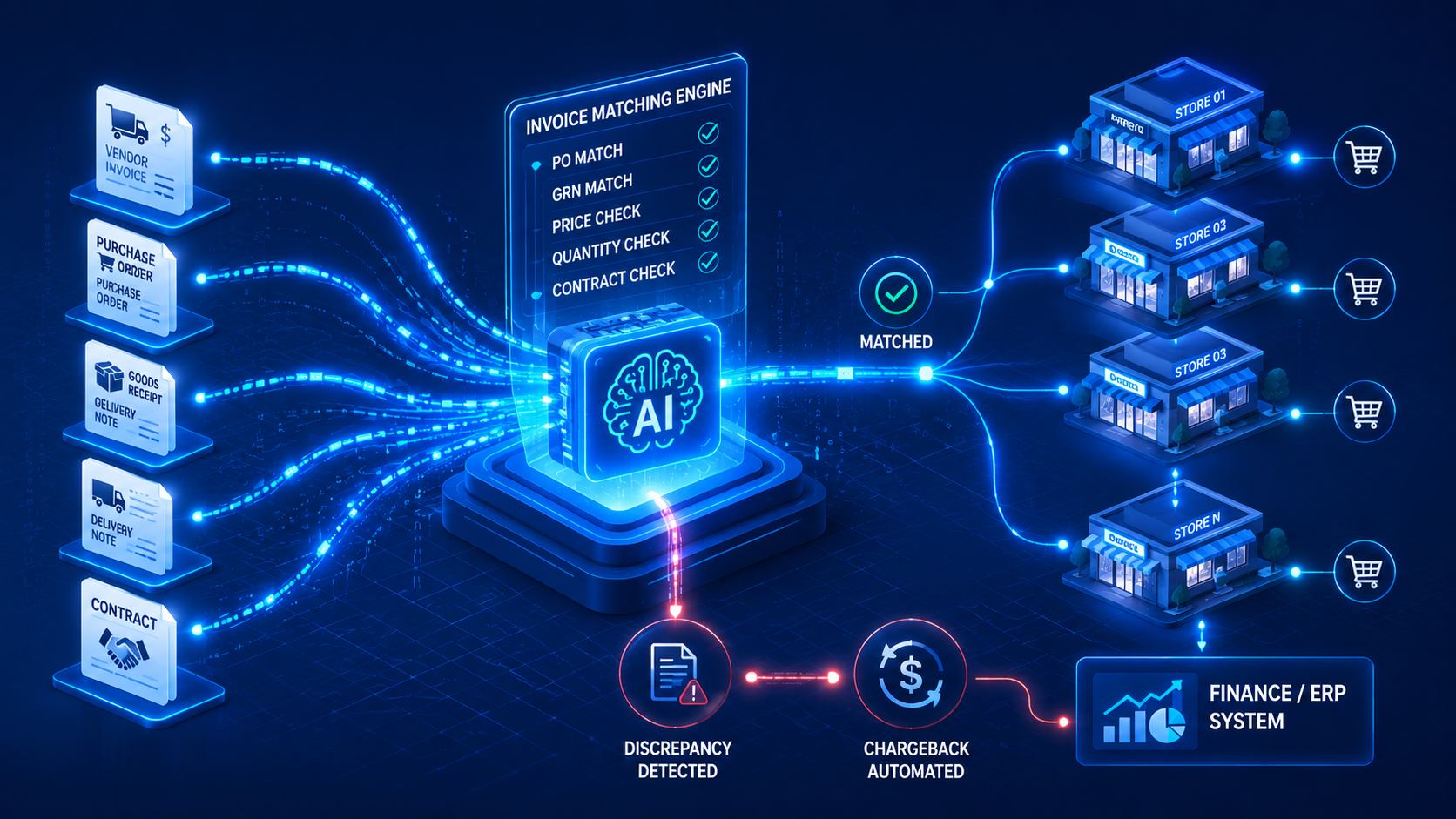
Automated three-way matching – purchase order, receipt, and invoice – compares these records the moment an invoice is captured, across every location, and surfaces genuine discrepancies immediately with the specific mismatch identified, such as a quantity difference or a price variance against contract terms.
This eliminates the need for someone to manually discover that the discrepancy exists in the first place.
It also shifts the dispute conversation from reactive to proactive. Instead of a vendor raising a dispute weeks after an invoice was paid, discrepancies surface at the point of invoice processing, before payment, when resolution is far simpler and less adversarial than unwinding an already completed transaction.
- Automatic three-way matching across every location a vendor relationship spans.
- Immediate identification of the specific discrepancy type, not a generic mismatch flag.
- Chargeback claims validated against receiving and inventory records automatically.
- Discrepancies surfaced before payment, not discovered reactively after a vendor dispute.
Why This Matters More as Retailers Add Locations
The scaling problem in retail vendor invoice management is specific and predictable. Every new location added to an existing vendor relationship multiplies the number of purchase order, receipt, and invoice combinations that need to be matched, without multiplying the finance team assigned to handle them.
Retailers that have grown their store count faster than their back-office finance capacity are usually the ones with the largest and most stubborn vendor dispute backlogs. Not because their vendors are more difficult, but because the matching volume has outpaced the manual process’s capacity to keep up.
Automating this matching layer removes the scaling penalty. Matching volume grows with transaction count, but the underlying automated process handles that growth without a proportional increase in finance headcount. This is exactly the constraint that otherwise limits how easily a retailer can expand its footprint or vendor base.
How Aptimeta Automates Vendor Matching and Chargebacks at Retail Scale
Aptimeta’s BOAT platform, powered by Studio and Orchestrator, automates three-way matching across every location and vendor relationship a retailer manages, validating purchase orders, receipts, and invoices continuously rather than only at month end.
DocuBrain can capture and validate invoices and supporting documents across different formats, while workflow orchestration connects the matching, validation, and resolution stages into a governed process.
Chargeback claims can be checked against receiving and inventory records, while Agentic AI manages recurring discrepancy patterns intelligently, applying documented resolution rules where appropriate and escalating genuinely novel disputes with full context attached.
For multi-location retailers where vendor dispute volume has grown faster than finance team capacity, this is the specific gap this automation is built to close – matching at the pace and scale the business has actually grown to, not the pace the manual process was originally designed for.