
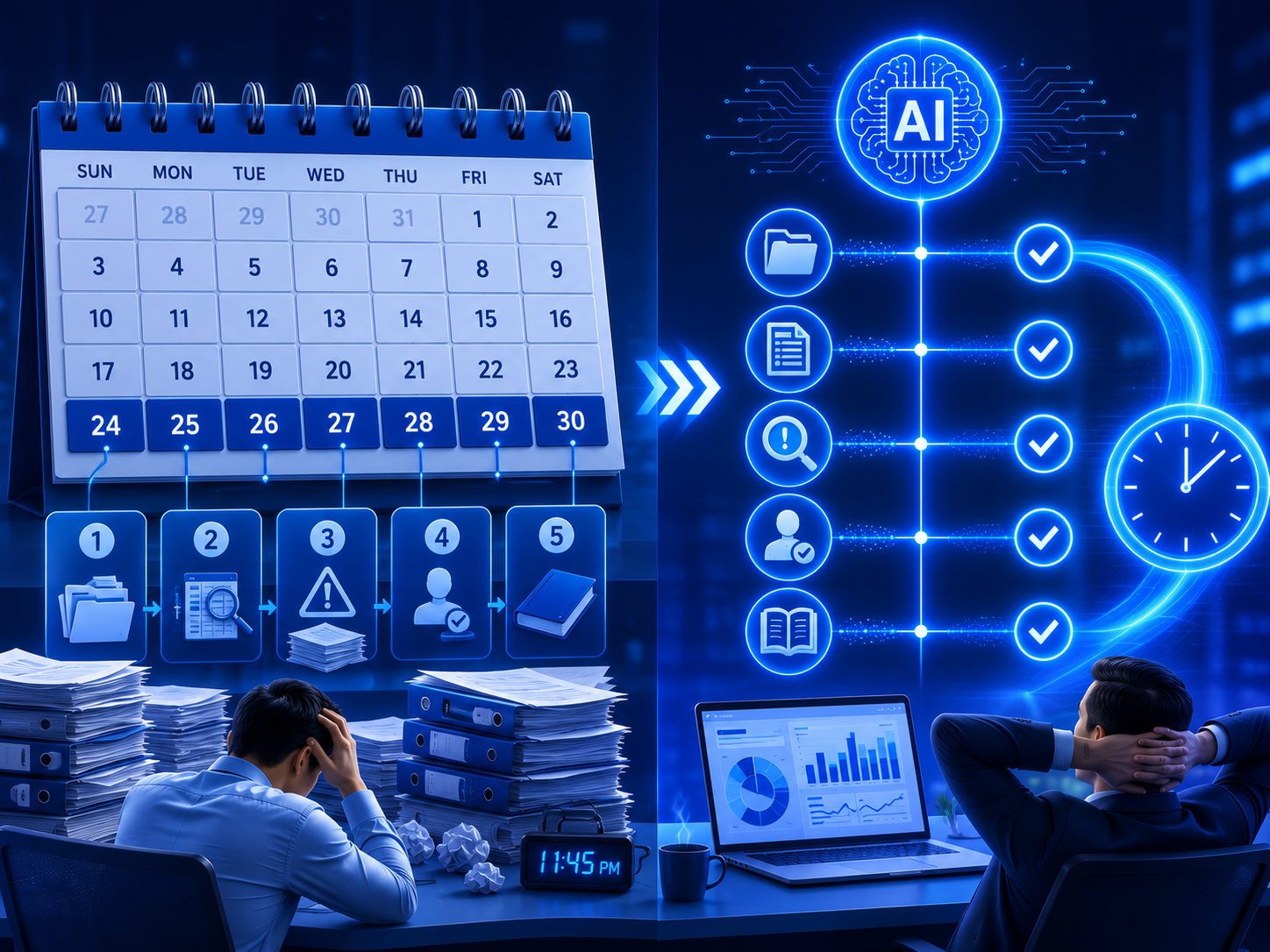
Reconciliation is one of the most time-consuming activities in enterprise finance. Every accounting period, finance teams gather data from the general ledger, bank statements, payment gateways, ERP systems, and subledgers before manually comparing thousands of transactions to identify discrepancies.
Although the matching process appears straightforward, the operational challenge lies in managing large transaction volumes spread across multiple disconnected systems.
Different data formats, inconsistent reference numbers, varying posting dates, and fragmented financial records make reconciliation a resource-intensive process that frequently delays the financial close.
Reconciliation Automation transforms this process by automating data collection, transaction matching, exception management, and audit documentation, enabling finance teams to close faster with greater accuracy.
Why Reconciliation Is a Document-Heavy Finance Process
Every reconciliation cycle begins with collecting financial data from multiple sources.
Bank statements often arrive as PDFs or CSV files. Payment processors generate reports using different transaction references than those stored in ERP systems. Subledger exports frequently require manual formatting before meaningful comparisons can begin.
Finance teams commonly rely on spreadsheets, formulas, and macros to standardise these files before reconciliation starts.
This approach introduces operational risk.
Even small changes to report layouts, transaction formats, or payment channels can disrupt reconciliation processes and require manual intervention during the financial close.
Controllers consistently identify data preparation—not transaction matching itself—as one of the most time-consuming phases of reconciliation.
Why Manual Reconciliation Doesn’t Scale
Traditional reconciliation depends heavily on spreadsheet comparisons and manual review.
Finance professionals compare transactions across multiple reports while relying on formulas that often assume every source file follows the same structure every month.
When formats change, formulas fail, requiring urgent manual adjustments during critical reporting periods.
Manual reconciliation also lacks continuous learning.
Recurring timing differences, payment settlement delays, and known reconciliation exceptions are investigated repeatedly because previous resolutions are not incorporated into future reconciliation cycles.
As transaction volumes increase through business growth, acquisitions, or new payment channels, reconciliation effort grows disproportionately, making month-end close increasingly difficult to manage.
How Intelligent Reconciliation Automation Works
Reconciliation Automation replaces manual transaction comparison with automated matching across connected financial systems.
Using DocuBrain Intelligent Document Processing, financial data is automatically captured, standardised, and normalised regardless of source format.
Transactions are then matched using configurable business rules that combine exact matching with intelligent similarity analysis.
- Automatic ingestion from bank feeds, ERP systems, payment gateways, and subledgers.
- Normalisation of structured and unstructured financial documents.
- Configurable exact matching rules for transaction values and reference numbers.
- Intelligent fuzzy matching for timing differences, rounding variations, and near matches.
- Automatic identification of genuine reconciliation exceptions.
- Structured evidence attached to every matched and unmatched transaction.
Instead of reviewing every transaction manually, finance teams focus only on genuine exceptions requiring professional judgement.
Continuous Reconciliation Improves Financial Close
Traditional reconciliation concentrates large volumes of work into the month-end close.
Continuous reconciliation distributes that effort throughout the accounting period.
Transactions are matched as they occur, allowing discrepancies to be identified and investigated days or weeks before financial reporting deadlines.
This significantly reduces pressure during month-end close while improving financial accuracy and reporting confidence.
Finance teams spend less time preparing data and searching for discrepancies, allowing greater focus on financial analysis, variance investigation, and business decision support.
Intelligent Exception Management with Agentic AI
Agentic AI extends reconciliation automation by learning from historical reconciliation outcomes.
Instead of treating every unmatched transaction as a completely new investigation, intelligent agents analyse previous reconciliation patterns and recommend likely resolutions.
Recurring timing differences, known settlement delays, and familiar transaction behaviours are recognised automatically.
Only genuinely new reconciliation issues require manual investigation, significantly reducing repetitive effort while improving consistency across reconciliation cycles.
How Aptimeta Automates Financial Reconciliation
Aptimeta provides end-to-end reconciliation automation through its BOAT platform by combining DocuBrain Intelligent Document Processing, Business Process Automation, workflow orchestration, Robotic Process Automation, and Agentic AI.
The platform connects directly to ERP systems, bank feeds, payment processors, and subledgers to automate data collection, document processing, transaction matching, exception management, approvals, and audit documentation.
Financial statements received as PDFs, scanned documents, spreadsheets, or structured data feeds are automatically standardised before reconciliation begins.
Agentic AI continuously analyses recurring exception patterns, recommends resolutions based on previous outcomes, and escalates only those discrepancies requiring human judgement.
Every transaction match, exception, approval, adjustment, and reconciliation decision is recorded within a structured audit trail, providing controllers, auditors, and finance leadership with complete visibility into every reconciliation cycle.
By transforming reconciliation from a manual month-end activity into an intelligent, continuous financial process, Aptimeta helps organisations accelerate financial close, improve reporting accuracy, strengthen compliance, and reduce operational effort across enterprise finance.
Discover how Aptimeta helps enterprises automate financial reconciliation through Intelligent Document Processing, Agentic AI, workflow orchestration, and end-to-end finance automation.