Traditional Robotic Process Automation (RPA) operates within clearly defined rules. Bots execute predefined instructions, and when an issue occurs, organisations can usually identify the specific rule responsible and make the necessary correction.
Agentic AI introduces a different operating model.
Rather than simply following rules, AI agents interpret business context, evaluate available information, and make decisions within an approved scope of authority.
This evolution creates new governance requirements.
Rather than asking whether an automation rule executed correctly, organisations must also understand why an autonomous decision was made, what information supported it, and whether the decision remained within authorised business boundaries.
As enterprises increasingly deploy Agentic AI across finance, operations, HR, procurement, and compliance, governance must become part of platform design—not an activity introduced after deployment.
Governance Requirements Change with Agentic AI
Traditional automation governance focuses on execution accuracy.
Agentic AI governance expands this responsibility by addressing questions such as:
- What decisions is the AI agent authorised to make?
- Which business data supported the decision?
- Was the information current and reliable?
- Can the decision be fully explained and reconstructed later?
These questions become particularly important in regulated environments including finance, healthcare, insurance, HR, and statutory compliance, where autonomous decisions may carry legal, financial, or operational consequences.
Define Decision Boundaries Before Deployment
Successful Agentic AI programmes establish clear decision authority before production deployment.
Every AI agent should operate within explicitly documented business limits.
Routine, policy-driven decisions may be handled autonomously, while transactions exceeding predefined thresholds should automatically escalate for human review.
Effective governance includes:
- Clearly documented decision authority.
- Defined escalation rules for exceptions.
- Complete logging of decision context.
- Regular governance reviews against business policies.
This approach ensures autonomous decision-making remains transparent, controlled, and aligned with organisational risk tolerance.
Data Quality Is a Governance Responsibility
Agentic AI can only make reliable decisions when the underlying business data is accurate, complete, and current.
If an AI agent operates on outdated or inconsistent information, it may confidently produce incorrect outcomes at enterprise scale.
For this reason, data quality becomes a governance requirement rather than simply an IT operational concern.
Organisations should establish clear controls around:
- Approved enterprise data sources.
- Data freshness and synchronisation.
- Validation of incomplete or inconsistent information.
- Automatic escalation when data confidence falls below acceptable thresholds.
Rather than allowing uncertain decisions to proceed, governed AI systems should defer to human judgement whenever confidence is insufficient.
Auditability Must Be Built Into Every Decision
One of the most important governance capabilities for Agentic AI is complete decision traceability.
Every autonomous action should produce a structured record showing:
- The information available at the time of the decision.
- The business context considered.
- The reasoning used by the AI agent.
- The final action performed.
- Whether human escalation occurred.
This level of auditability enables organisations to explain AI-driven decisions confidently during internal reviews, external audits, regulatory inspections, and compliance assessments.
Rather than relying on opaque automation, enterprises gain transparent decision records that strengthen governance and operational trust.
How Aptimeta Delivers Governed Agentic AI
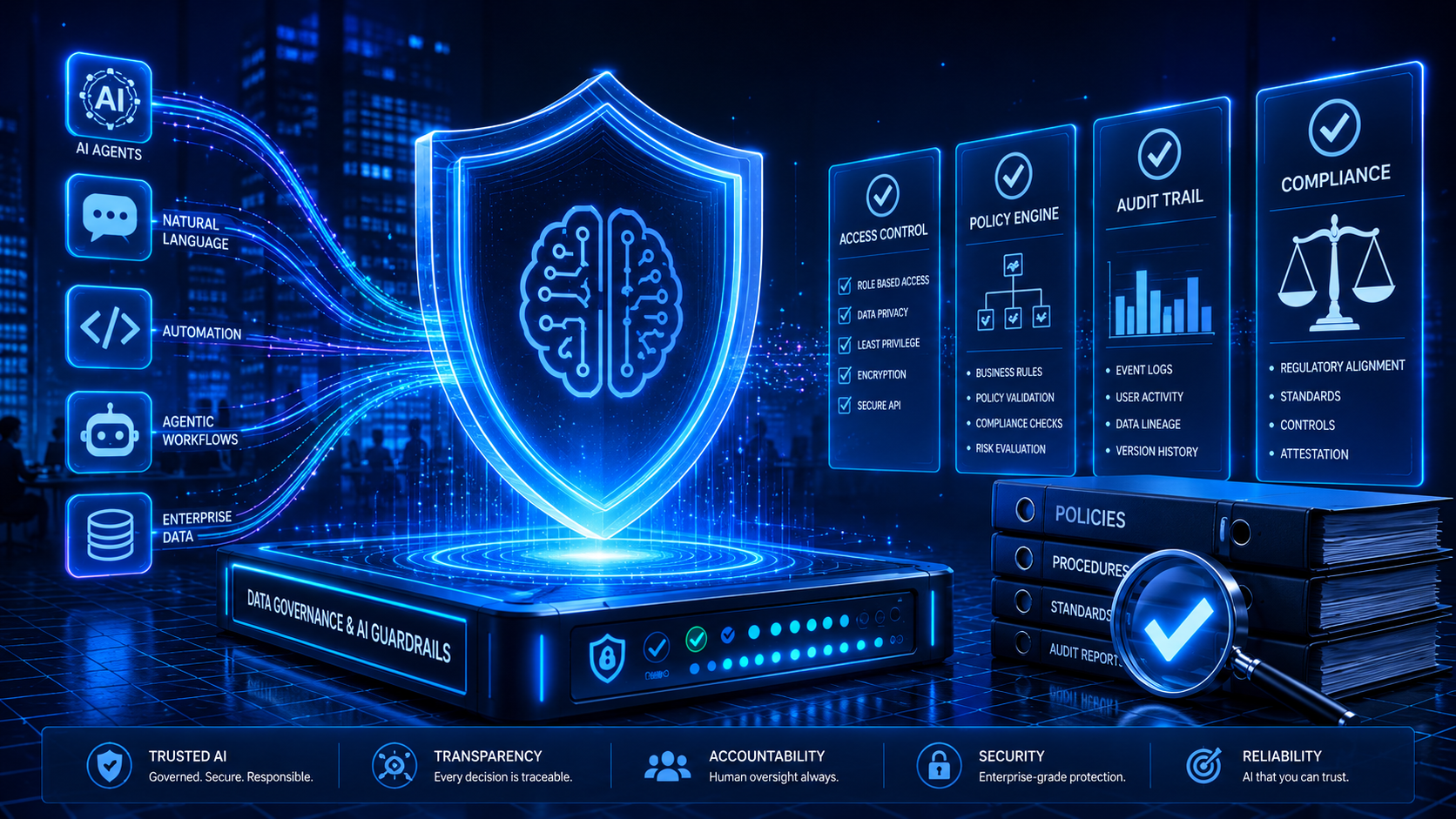
Aptimeta embeds governance directly into its Agentic AI platform through the BOAT architecture, powered by Studio and Orchestrator.
Every AI agent operates within clearly defined decision boundaries established during workflow design.
Workflow orchestration automatically applies escalation policies whenever transactions exceed authorised decision thresholds or confidence levels fall below acceptable standards.
Every autonomous decision is recorded together with the supporting business context, source data, reasoning pathway, approvals, and workflow history.
Integrated governance capabilities provide:
- Explicit decision authority management.
- Automated confidence-based escalation.
- Complete reasoning audit trails.
- End-to-end workflow visibility.
- Governed execution across finance, compliance, HR, procurement, and enterprise operations.
Building Responsible Enterprise AI
As organisations expand Agentic AI across business-critical operations, governance becomes a strategic capability rather than a regulatory obligation.
Enterprises that define decision boundaries, strengthen data governance, maintain transparent audit trails, and embed human oversight into autonomous workflows are best positioned to scale AI confidently while meeting operational, compliance, and regulatory expectations.
Discover how Aptimeta enables responsible enterprise AI through governed Agentic AI, workflow orchestration, Intelligent Document Processing, and Business Process Automation—delivering autonomous decision-making with transparency, accountability, and enterprise-grade governance built into every workflow.