
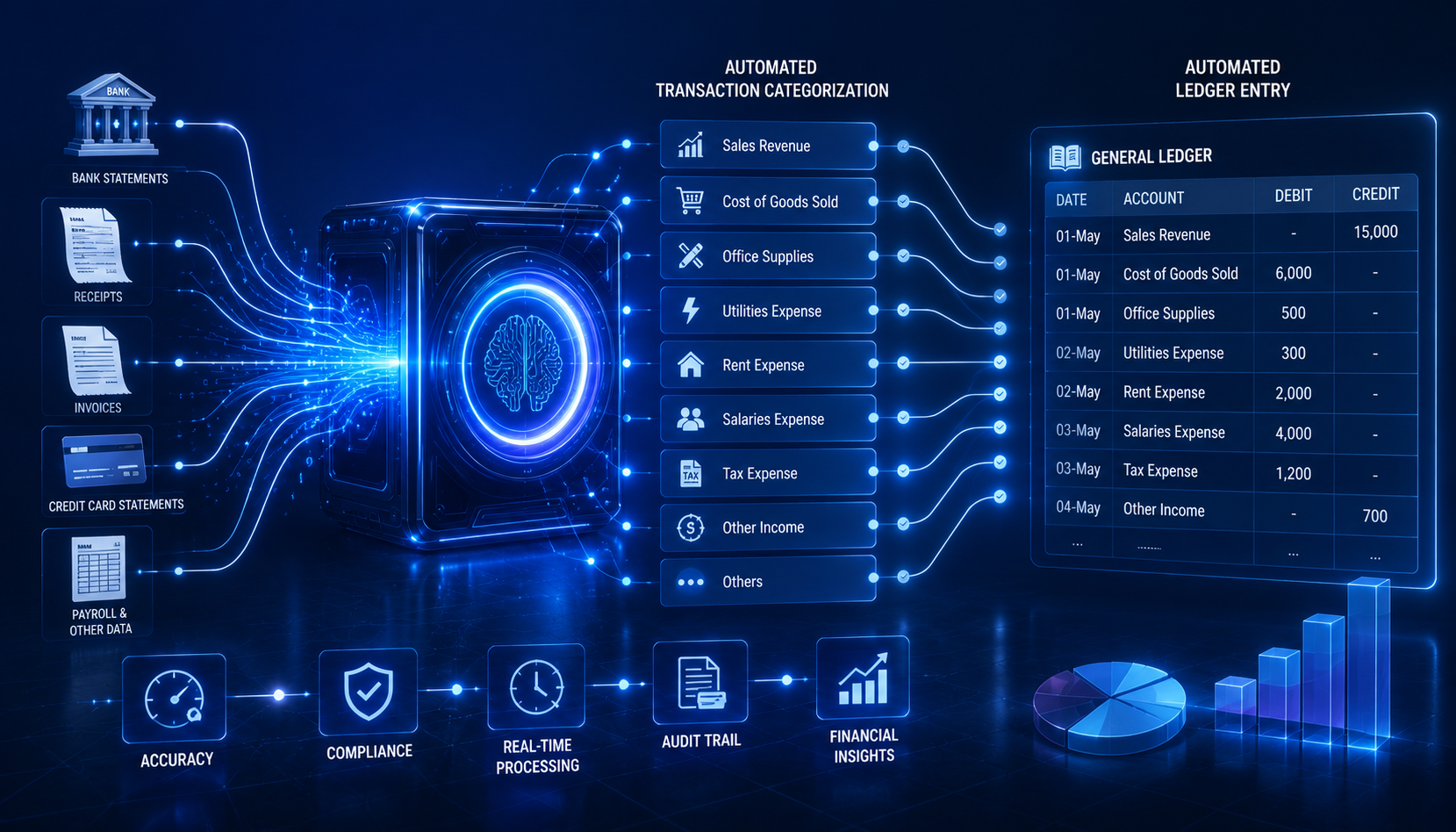
How Automated Bookkeeping Works: From Transaction Capture to Ledger Posting
It helps to understand automated bookkeeping the way it actually functions day to day, not as an abstract concept but as a specific sequence. Transactions get captured from bank feeds and connected systems, categorised against the chart of accounts, posted to the ledger, and flagged for review where genuine ambiguity exists.
Each of these steps replaces a piece of what a bookkeeper currently does manually, without replacing the bookkeeper’s role in the process entirely.
Step One: Capturing Transactions From Every Connected Source
Automated bookkeeping starts by ingesting transactions directly from bank feeds, credit card statements, payment processors, and connected business systems, rather than requiring someone to manually export and import transaction data on a recurring schedule.
This alone removes a meaningful chunk of administrative time that currently goes into simply gathering raw transaction data before any actual bookkeeping work can begin.
Step Two: Categorising Against the Chart of Accounts
Once captured, each transaction needs to be categorised and assigned to the correct account in the chart of accounts. This is where automated pattern recognition does most of its work.
The system learns from historical categorisation decisions specific to the business. A particular vendor may consistently be categorised as a specific expense type, while a particular deposit pattern may consistently represent a specific revenue stream. The system can apply these learned patterns automatically to new transactions that match.
This learning is specific to each business’s actual categorisation history, rather than a generic rule set applied uniformly across every company. This matters because chart of accounts structures and categorisation conventions genuinely vary between businesses, even when transactions appear superficially similar.
- Automated transaction capture from bank feeds, cards, and connected systems.
- Pattern-based categorisation learned from each business’s own historical decisions.
- Automatic posting to the ledger for transactions matching established, high-confidence patterns.
- Flagging of new or ambiguous transactions for bookkeeper review before posting.
Step Three: Posting to the Ledger With Confidence Thresholds
Not every categorised transaction should post automatically without review. A well-designed automated bookkeeping process applies confidence thresholds.
Transactions matching a well-established, high-confidence pattern can post automatically, while transactions that are similar but not an exact match, or that represent a genuinely new pattern the system has not seen before, are flagged for a bookkeeper’s review before posting.
This prevents transactions from being forced through automatically and potentially miscategorised.
This threshold-based approach is what keeps automated bookkeeping trustworthy rather than simply fast. Speed without accuracy is not useful in a bookkeeping context, since a miscategorised transaction that flows through unnoticed can distort financial reporting until someone eventually catches and corrects it.
Step Four: Where Human Review Still Matters Most
The transactions that genuinely benefit from a bookkeeper or accountant’s judgement are the ones automation is specifically designed to surface, not hide.
Examples include a new vendor relationship with no categorisation history, an unusual one-time transaction, or a transaction that could plausibly fit two different categories depending on business context that the automated system does not have visibility into.
These are exactly the cases where human judgement adds real value, and automated bookkeeping is built to route these cases to a person rather than guessing.
Over time, as a bookkeeper makes these judgement calls, the system can learn from them. This means the category of transactions requiring manual review can narrow as the historical pattern base for a given business grows, rather than remaining static indefinitely.
Step Five: Keeping the Chart of Accounts Current
Automated bookkeeping also supports the ongoing maintenance of the chart of accounts itself.
The system can flag when a new type of recurring transaction may warrant its own account category or when an existing category has drifted to include transactions that no longer belong together cleanly.
This is a maintenance task that often gets neglected in manual bookkeeping simply because nobody has enough time to step back and review the categorisation structure itself, rather than just processing the individual transactions flowing through it.
How Aptimeta Runs Automated Bookkeeping End to End
Aptimeta’s BOAT platform, powered by Studio and Orchestrator, automates transaction capture, categorisation, and ledger posting with confidence thresholds that route genuinely ambiguous or novel transactions to a bookkeeper for review rather than posting them automatically.
Agentic AI learns from each business’s own historical categorisation decisions, helping identify recurring transaction patterns and determine which entries can be processed automatically.
Workflow orchestration manages the movement of transactions through capture, categorisation, review, and ledger posting while ensuring exceptions reach the appropriate finance professional.
Every automated and manually reviewed entry is logged in a structured, audit-ready record, providing finance teams with visibility into how transactions were categorised and processed.
The result is a bookkeeping process where repetitive, high-volume categorisation work is handled automatically, while a bookkeeper’s time is directed toward the transactions and chart of accounts decisions that genuinely require their judgement.
Discover how Aptimeta helps finance teams automate bookkeeping with intelligent transaction categorisation, confidence-based processing, workflow orchestration, and Agentic AI while keeping human judgement at the centre of financial decision-making.