
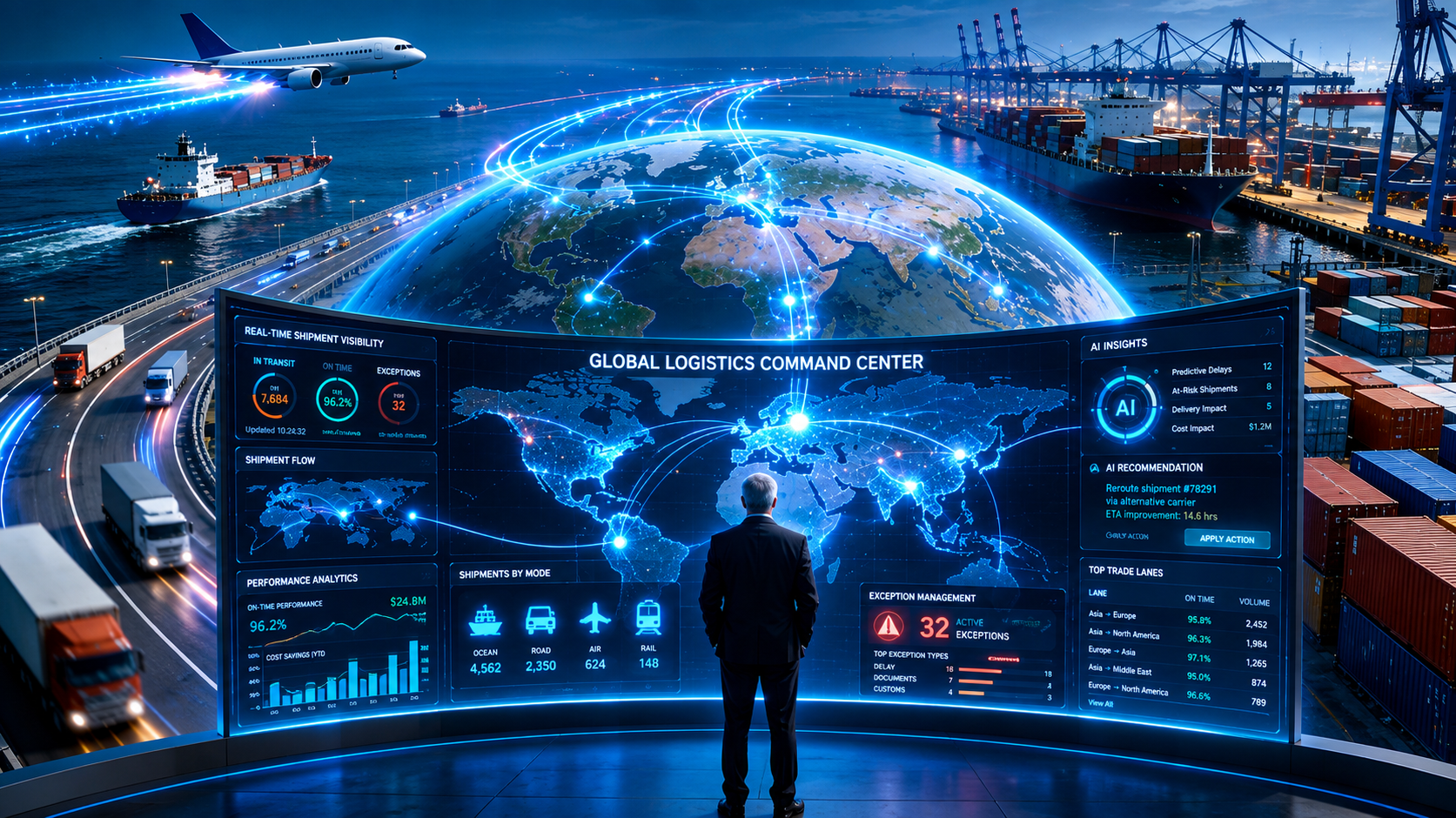
Every logistics operation, regardless of how carefully it is planned, encounters exceptions. Vessels are delayed, connections are missed, pallets arrive damaged, and shipments can be held by customs without warning.
The difference between a logistics operation that absorbs these disruptions and one that allows them to cascade into larger delays is not whether exceptions occur. They always will. The difference is how quickly and intelligently the organisation responds.
Traditional logistics exception management still relies heavily on static rules. A shipment delayed beyond a predefined threshold triggers an alert. A customs hold sends a notification to a designated employee. These mechanisms provide useful automation, but they generally treat exceptions according to predefined conditions rather than the actual business context surrounding each event.
This can result in two problems: genuinely urgent exceptions may not receive the required response quickly enough, while relatively minor issues may trigger unnecessary escalation.
Why Static Rules Struggle with Real-World Logistics Exceptions
A rule that triggers an alert whenever a shipment exceeds a specific delay threshold cannot inherently distinguish between a shipment carrying time-sensitive goods and one containing inventory with a flexible delivery window.
Both shipments may trigger the same alert even though their commercial impact is completely different.
Static rules also struggle to account for downstream dependencies.
A delayed inbound shipment supporting a just-in-time manufacturing line may require immediate intervention, while the same delay involving general warehouse inventory may have minimal operational impact.
Unless every possible scenario has been explicitly defined in advance, a rule-based system has limited ability to evaluate these relationships dynamically.
From Exception Detection to Exception Assessment
Agentic AI introduces a more contextual approach to logistics exception management.
Instead of simply detecting that an exception has occurred, an AI agent can assess the surrounding circumstances—including what is being shipped, who the customer is, the committed delivery window, downstream dependencies, and the potential business impact.
This allows different responses to be applied to different situations.
A delay affecting a high-value, time-sensitive shipment may trigger immediate customer communication and an assessment of alternative transportation options.
A low-priority shipment with sufficient delivery flexibility may simply be monitored without unnecessary escalation.
The advantage is that organisations do not need to create an increasingly complex rule for every possible combination of shipment, customer, route, and dependency. The agent evaluates the available context dynamically.
Proactive Customer Communication During Delays
Shipment delays are traditionally handled reactively. A customer notices that a delivery has not arrived, contacts the logistics provider, and an employee then investigates the shipment status before responding.
Agentic AI enables a proactive model.
An agent monitoring shipment activity can identify a developing delay, evaluate its potential impact against the committed delivery window, and initiate appropriate communication before the customer needs to ask for an update.
- Context-aware assessment based on shipment type, customer requirements, and downstream dependencies.
- Proactive customer communication before a status inquiry is received.
- Automatic escalation only when human intervention or judgement is genuinely required.
- Continuous improvement based on outcomes from comparable historical exceptions.
Coordinating Rerouting Across Carriers and Transportation Modes
Some logistics exceptions require more than communication. A port closure, carrier capacity shortage, or major route disruption may require the organisation to evaluate alternative carriers, transportation modes, and routes under significant time pressure.
An AI agent can gather the relevant information, evaluate available alternatives, and compare factors such as cost, transit time, capacity, and reliability.
Instead of requiring a logistics coordinator to manually research every option during an active disruption, the agent can provide a ranked set of viable alternatives with the relevant context already assembled.
The logistics professional remains responsible for significant commercial decisions where human judgement is required. The automation removes the time-consuming research and comparison work that would otherwise delay that decision.
How Aptimeta Applies Agentic AI to Logistics Exceptions
Aptimeta integrates Agentic AI into logistics workflows to help organisations identify, assess, and respond to shipment exceptions within a governed operational environment.
Through its Business Process Automation and workflow orchestration capabilities, shipment events can be evaluated against customer commitments, shipment characteristics, operational dependencies, and predefined business policies.
Agentic AI can manage straightforward responses autonomously, including proactive communications and routine exception actions. For complex situations, it can gather relevant information, assess available options, and escalate the case to the appropriate logistics professional with the supporting context already assembled.
Every agent action, decision, and escalation is recorded in a structured audit trail, providing logistics leadership with visibility into how exceptions are being managed across the network.
Moving from Reactive Alerts to Intelligent Exception Management
Logistics disruptions cannot be eliminated. What organisations can change is how quickly and intelligently they respond to them.
Static rules remain valuable for predictable events, but they are not sufficient for the contextual, interconnected nature of modern supply chain operations.
By combining intelligent orchestration with Agentic AI, organisations can move from simply detecting exceptions to understanding their business impact and coordinating the most appropriate response.
The result is a logistics operation that is better equipped to absorb disruption, protect customer commitments, optimise response decisions, and maintain visibility across the entire exception lifecycle.
Discover how Aptimeta helps logistics and supply chain teams move from rule-based exception alerts to intelligent, context-aware exception management powered by Agentic AI and workflow orchestration.