
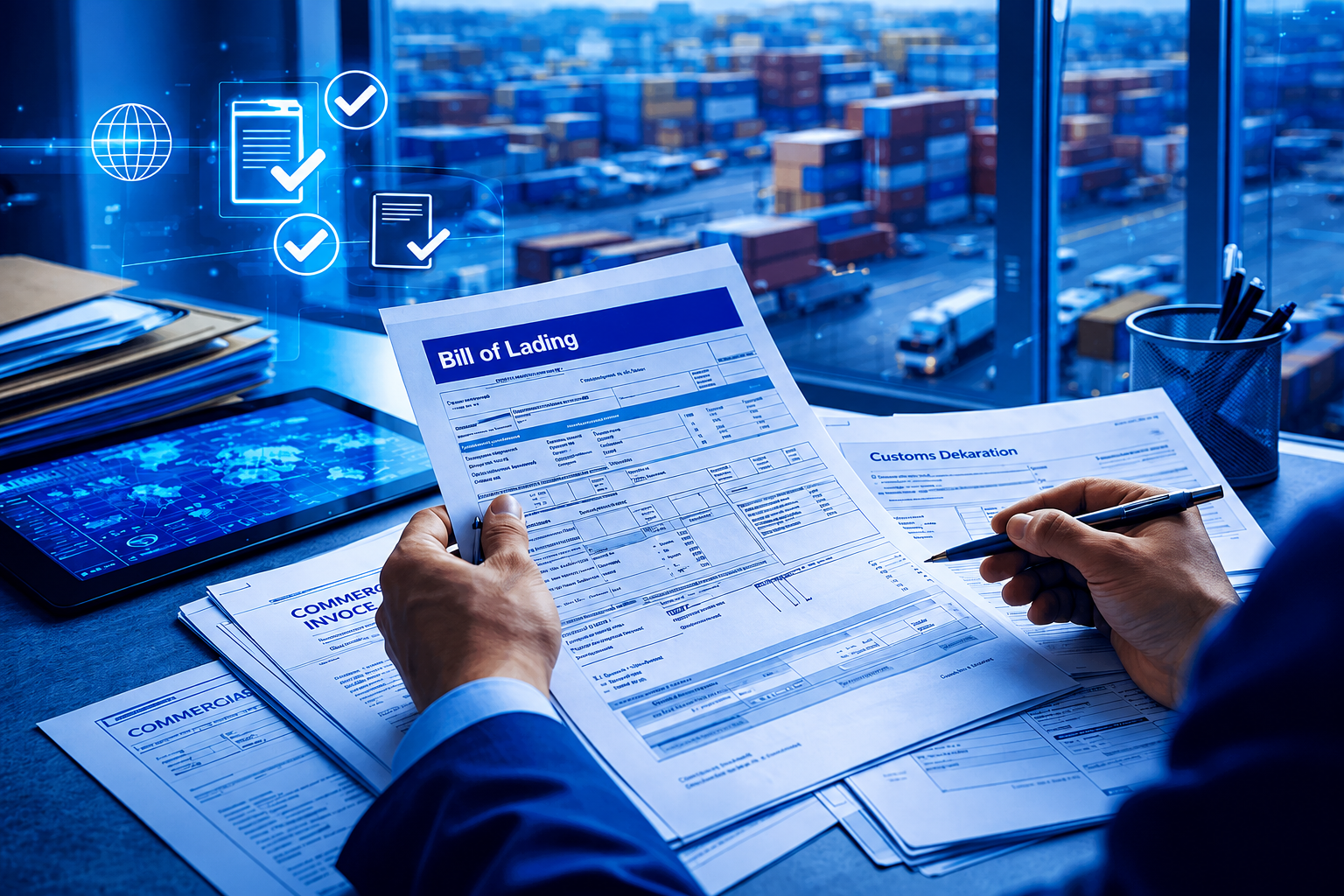
Freight and logistics operations depend on physical movement—trucks, containers, warehouses, and distribution networks. But the processes that determine whether a shipment moves smoothly are often driven by documents.
Bills of lading, customs declarations, proof of delivery documents, certificates of origin, and other freight records must be created, validated, matched to shipments, and passed to the next party in the supply chain.
In many logistics environments, these activities still depend on email attachments, scanned documents, PDFs, and physical paperwork.
The result is a hidden operational bottleneck. Physical goods may be moving efficiently, while the documentation required to authorise, track, invoice, and complete those movements continues to move slowly.
Logistics automation addresses this document layer by automating how freight documentation is captured, validated, matched, and routed—helping organisations reduce administrative delays without changing the physical movement of goods.
Why Freight Documents Are Difficult to Standardise
Freight documentation involves multiple independent parties, including shippers, carriers, freight forwarders, customs authorities, warehouses, and consignees.
Each organisation may use different systems, document formats, and operating processes.
A bill of lading from one carrier can look completely different from one generated by another. Customs documentation can also vary significantly depending on the country, commodity, and regulatory requirements involved.
This makes email, PDF, scanned documents, and even fax practical communication methods between organisations that do not share a common technology platform.
The challenge is therefore not simply digitising documents. It is making different documents understandable and actionable across a fragmented logistics ecosystem.
Where Freight Documentation Creates Delays
A single shipment can generate numerous documents throughout its journey.
At each handoff, someone may need to verify that:
- The document belongs to the correct shipment.
- Required fields are complete.
- Quantities and shipment details match.
- Required signatures or approvals are present.
- The documentation meets regulatory requirements.
When these checks are performed manually, processing speed depends on staff availability rather than shipment velocity.
Proof of delivery is a particularly important example. A shipment may have physically reached its destination, but if the signed proof of delivery has not reached the finance or logistics system, invoicing and payment processes may remain pending.
This creates a gap between physical completion and documentary completion.
Automating Freight Document Capture and Validation
Intelligent Document Processing (IDP) can capture and interpret freight documents regardless of their original format.
A scanned bill of lading, photographed proof of delivery, PDF customs declaration, or certificate of origin can be automatically classified and processed.
The extracted information can then be validated against the associated shipment record.
Documents containing missing information, inconsistent quantities, incorrect shipment references, or other discrepancies can be identified immediately and routed for review.
- Automated extraction from bills of lading, customs documentation, and proof of delivery records.
- Validation against shipment and transport records.
- Immediate identification of missing or inconsistent information.
- Faster processing of proof of delivery to support invoicing.
- Consistent digital records across multi-party shipment processes.
Why Document Automation Becomes More Important at Scale
Manual document processing becomes increasingly difficult as shipment volumes grow.
Every additional shipment generates additional documentation, validation requirements, and coordination points. New carriers, suppliers, trading partners, and document formats introduce further variations into the process.
This can cause administrative workloads to grow faster than shipment volumes because each new document type introduces additional handling requirements.
Automating document capture and validation changes the scaling model.
Instead of adding more manual processing capacity as shipment volumes increase, organisations can use intelligent automation to handle higher document volumes while maintaining consistent validation and routing processes.
How Aptimeta Automates the Freight Document Chain
Aptimeta brings document processing, automation, and workflow orchestration together through its BOAT platform.
DocuBrain captures and processes bills of lading, customs forms, proof of delivery documents, certificates of origin, and other freight documentation across different formats and sources.
The extracted information can be validated against shipment records, while Robotic Process Automation (RPA) handles repetitive system updates and data entry across transportation, logistics, and enterprise applications.
Workflow orchestration coordinates the movement of documents between teams, systems, and external parties, ensuring that the next process step is triggered automatically rather than waiting for a manual handoff.
Every document can be tracked throughout its lifecycle, providing logistics teams with greater visibility into document status, exceptions, and outstanding actions.
Turning the Document Layer into a Logistics Advantage
Physical transportation has become increasingly connected through GPS tracking, fleet management, warehouse technology, and real-time shipment visibility.
The documentation surrounding those movements has not always evolved at the same pace.
Automating the freight document layer helps close that gap by connecting document capture, validation, system updates, and workflow execution into one coordinated process.
Discover how Aptimeta helps logistics organisations automate freight documentation, accelerate proof-of-delivery processing, reduce manual validation, and keep shipments moving through intelligent document processing, RPA, and workflow orchestration.