
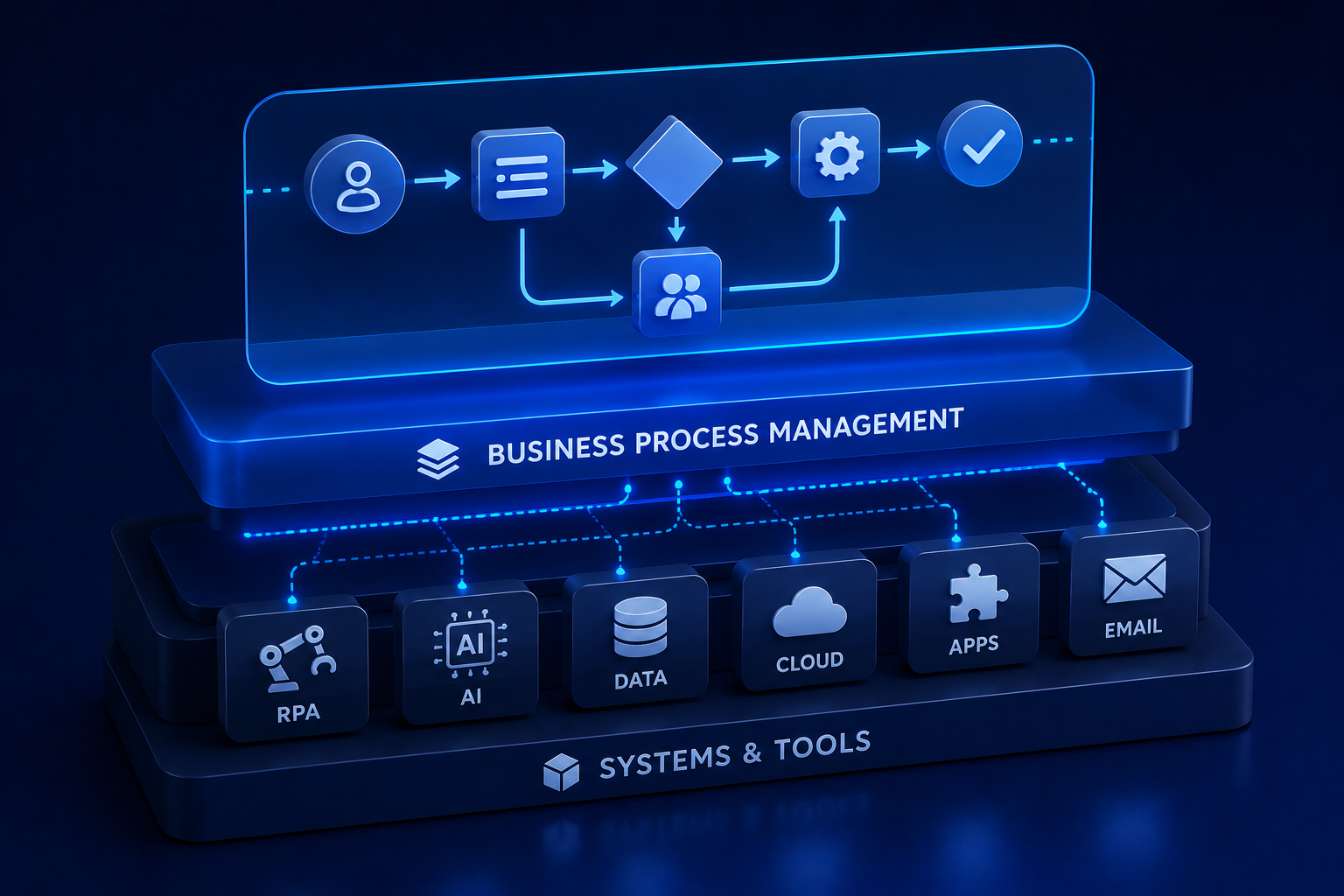
Organisations have invested heavily in automation over the past decade. RPA bots handle data entry. Workflow tools route approvals. Specialised platforms manage invoices or onboarding. Yet a common and frustrating pattern persists: despite all this investment, business leaders report that their automation is fragmented, hard to scale, and difficult to maintain.
The reason is usually the same. These organisations automated tasks without first designing the process. They added bots and tools without establishing the governance layer that holds them together. What they are missing is Business Process Management – and without it, automation rarely delivers its full potential.
This guide explains what BPM is, how it differs from other automation technologies, and why it serves as the essential foundation for any serious enterprise automation programme.
What Is Business Process Management?
Business Process Management (BPM) is both a discipline and a technology. As a discipline, it is the practice of designing, documenting, executing, monitoring, and continuously improving the workflows that run your organisation. As a technology, it is the platform that enables those activities at scale.
A BPM system gives organisations the ability to model how work should flow- who does what, in what sequence, under what conditions, and with what data. Once modelled, those processes can be deployed as live, executable workflows that coordinate people, systems, and automated tasks in a governed, visible, and auditable way.
The key word is governed. BPM is not just about making processes faster. It is about making them consistent, measurable, and manageable. A process that runs through a BPM platform can be monitored in real time, measured against KPIs, and optimised based on actual performance data.
BPM vs RPA: Two Different Things
One of the most common points of confusion in enterprise automation is the relationship between BPM and RPA. Both are automation technologies, but they operate at fundamentally different levels.
Robotic Process Automation (RPA) automates specific tasks. An RPA bot can log into a system, extract data from a screen, copy it into another application, and submit a form. It is a task-level automation tool. It does one defined thing, repeatedly, quickly, and accurately.
BPM operates at the process level. It does not automate individual tasks-it designs, sequences, and governs the end-to-end flow of work. A BPM platform determines when a task should be performed, by whom or by what automation, and what happens next based on the outcome.
The practical difference becomes clear in an example. Consider an employee onboarding process. An RPA bot might automate the task of creating a user account in an HR system. But BPM governs the entire onboarding journey: triggering the process when an offer is accepted, routing the identity verification step to the HR team, passing credentials to the IT provisioning step once verification is complete, flagging exceptions when a step overruns its SLA, and confirming completion to the manager. RPA does a step. BPM coordinates the whole process.
Organisations that try to build enterprise automation on RPA alone-without BPM-consistently encounter the same problems. The bots work, but the process does not hold together. There is no visibility across the end-to-end flow. Exception handling is manual and inconsistent. Scaling requires re-engineering each bot individually. Maintenance becomes increasingly expensive as the number of bots grows.
The Four Stages of BPM
A BPM system operates across four stages that form a continuous improvement loop.
1. Model
Processes are designed using visual modelling tools. Stakeholders map out the flow of work-steps, decisions, roles, systems, data, and rules. Good BPM tools use standards like BPMN (Business Process Model and Notation) to ensure processes are documented in a structured, consistent way.
2. Execute
The modelled process becomes a live, running workflow. Tasks are assigned. Automations are triggered. Decisions are made based on configured business rules. The process runs as designed, with the BPM engine coordinating every step.
3. Monitor
Every running process instance generates performance data. Cycle times, completion rates, exception volumes, SLA compliance, and bottlenecks are visible in real time. Process owners can see exactly where work is flowing well and where it is stalling.
4. Optimise
Performance data drives improvement. Bottlenecks are addressed. Rules are refined. Steps that can be automated are automated. The process is remodelled and redeployed-closing the loop and ensuring continuous improvement over time.
This cycle is what distinguishes BPM from static workflow tools. A workflow tool routes work. A BPM system manages, measures, and continuously improves the process.
What Happens Without BPM
It is worth being concrete about what the absence of BPM looks like in practice because many organisations are living it right now.
Without BPM, automation tends to grow organically and inconsistently. Teams automate what is painful to them, using whatever tools are available. Over time, the organisation accumulates a collection of disconnected automations: bots that do not communicate with each other, workflow tools with no integration, spreadsheets filling the gaps between systems.
Operational teams in this situation consistently report the same issues:
- No end-to-end visibility.
- Fragile automation.
- Inconsistent exception handling.
- High maintenance burden.
- Inability to scale.
BPM addresses all of these problems by establishing a governance layer that holds automation together and makes it manageable.
BPM in Practice: Three Real-World Processes
Accounts Payable
Accounts Payable is one of the clearest BPM use cases. A BPM platform governs the entire AP process-receiving the invoice (fed by IDP), matching it against the purchase order and goods receipt, routing it to the appropriate approver based on value and cost centre, handling exceptions when there is a discrepancy, and triggering payment once approved.
Employee Onboarding
Employee onboarding spans HR, IT, finance, and the hiring manager’s team. Without BPM, onboarding is typically a series of emails and manual steps, prone to delays and inconsistencies. A BPM platform sequences every step-contract issuance, identity verification, system access provisioning, equipment assignment, induction scheduling-with SLAs on each task and automatic escalation when timelines slip.
Customer Complaint Handling
Customer complaint handling requires consistent routing, response, and resolution. BPM governs the intake of the complaint, the assignment to the right team, the customer communication steps, the escalation path for unresolved issues, and the closure and follow-up.
BPM as the Foundation of the Aptimeta Platform
Aptimeta is built on a unified BPM engine that serves as the coordination layer for everything else. RPA bots execute tasks within BPM-governed processes. IDP extracts document data that feeds directly into BPM-managed workflows. Agentic AI handles decision-making and exception resolution within the process context.
This architecture reflects how enterprise automation should work. The bots and AI do not operate in silos-they are deployed as components of well-designed, well-governed business processes. The result is automation that is coherent, scalable, and genuinely manageable.
For organisations that have already invested in RPA and are finding it difficult to scale, BPM is almost always the missing layer. It does not replace what you have built. It provides the governance framework that makes it work as a system.