
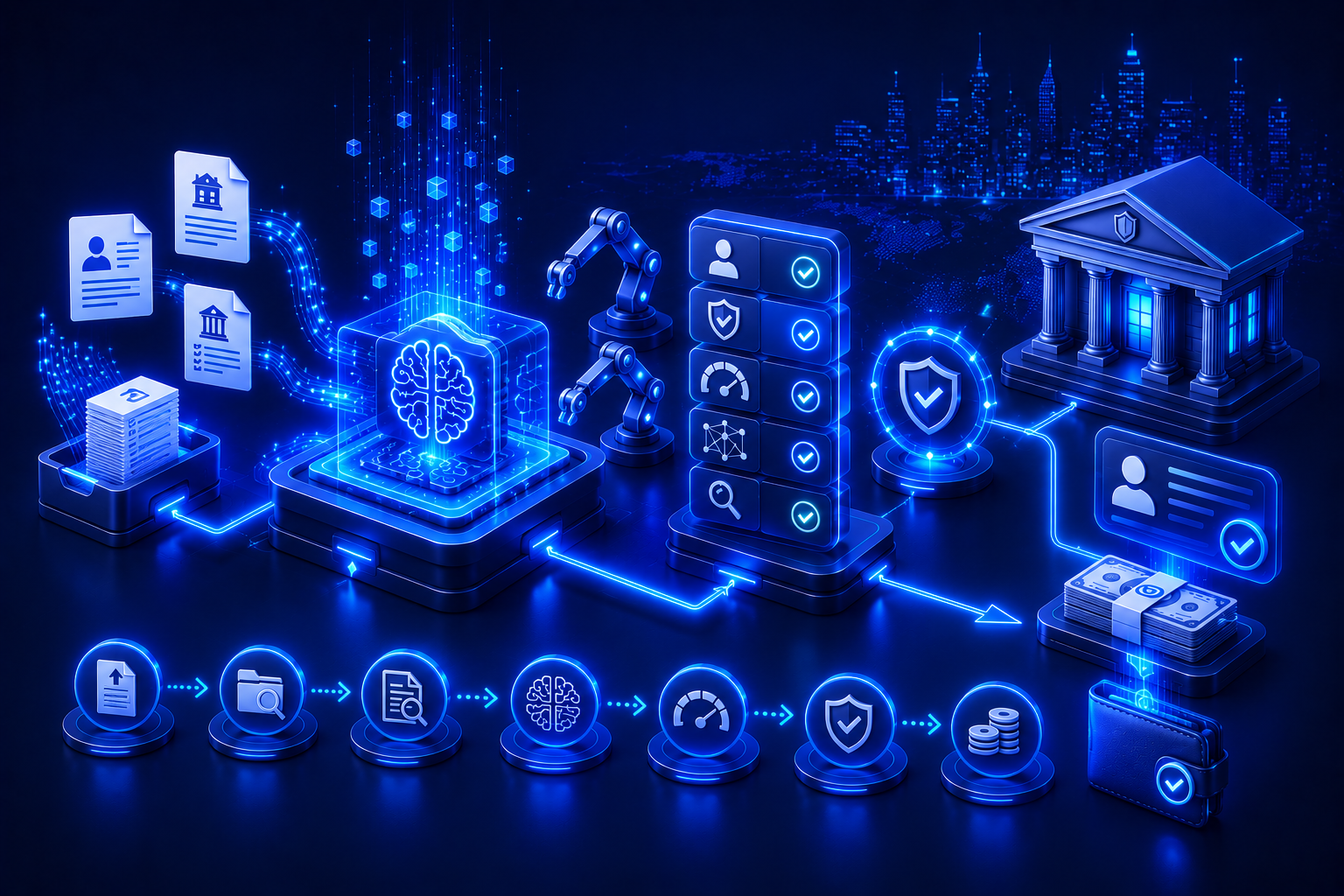
A small business owner applies for a working capital loan. The application goes into a queue. An operations analyst manually keys in the applicant’s financials from uploaded PDFs. A credit officer requests additional bank statements. The bureau pull happens two days later because the system access sits with a different team. By the time an underwriter reviews the file, ten days have passed – and the applicant has found financing elsewhere.
This scenario plays out across retail lenders, mortgage providers, and SME banks every day. Loan origination is one of the most document-intensive, multi-step processes in financial services, and at most institutions, a significant portion of it is still handled manually. The result is approval timelines measured in days or weeks rather than hours, inconsistent underwriting outcomes, and a compliance exposure that grows with every undocumented manual decision.
Intelligent Document Processing (IDP), BPM-led workflow orchestration, and Agentic AI are changing the economics of loan origination – not by removing human judgment from underwriting, but by eliminating the manual work that surrounds it.
The Manual Loan Origination Problem
Loan origination spans application intake, identity and income verification, credit bureau assessment, collateral or asset valuation, underwriting, regulatory compliance checks, approval, and disbursement. Each of these steps involves documents, data, and systems – and in most institutions, the connective tissue between them is human effort.
Operations leaders at lending institutions consistently identify the same failure points:
- Document chasing: Applicants submit incomplete packages; analysts follow up manually and wait for resubmission before the process can continue.
- Manual data re-entry: Income statements, bank statements, and property documents are read and re-keyed into origination systems, introducing transcription errors that propagate downstream.
- Sequential handoffs: Credit processing is structured as a chain of sequential tasks, each waiting for the previous to complete, with no parallel processing.
- Underwriter overload: Underwriters spend a disproportionate share of their time on document review and data gathering rather than on actual credit judgment.
- Compliance gaps: Manual processes create inconsistent audit trails, making it difficult to demonstrate that every required check was performed for every application.
For retail home loan applicants, these delays translate to frustration and attrition. For SME borrowers with working capital urgency, they translate to lost business relationships. For lenders, they translate to reduced throughput and increased cost per loan originated.
IDP for Document-Heavy Lending Steps
The most document-intensive steps in loan origination – income verification, address confirmation, asset documentation, and identity validation – are also the steps where IDP delivers the most immediate impact.
In a lending workflow, IDP handles:
- Income statement extraction: Automated parsing of salary slips, Form 16, and employment letters to extract income figures, employer details, and tenure information.
- Bank statement analysis: Extraction of transaction history, average balance, income credits, and EMI obligations from multi-page bank statements, including identification of irregular patterns.
- Property and asset documents: Extraction of key fields from title deeds, valuation reports, and registration documents for mortgage and secured lending applications.
- Identity and KYC documents: Classification and field extraction from national IDs, passports, and address proofs, with cross-validation against application data.
- Financial statement processing for SME lending: Extraction of P&L, balance sheet, and cash flow figures from uploaded financial statements, feeding directly into credit assessment models.
The critical improvement over manual processing is not just speed – it is consistency. IDP applies the same extraction and validation logic to every document, every time, eliminating the variance that manual handling introduces into the data that feeds credit decisions.
BPM and Workflow Orchestration for End-to-End Sequencing
IDP handles the document layer, but the full origination process requires an orchestration layer that sequences every step from application intake to disbursement, manages parallel tracks, enforces SLAs, and ensures that nothing falls through the gaps between systems.
A BPM-led loan origination workflow orchestrates:
- Application intake and completeness check: Automatic validation that all required documents and data fields are present before the application enters the processing queue.
- Parallel track execution: Credit bureau pull, AML screening, and document extraction running simultaneously rather than sequentially, reducing overall cycle time.
- System integration sequencing: Structured data from IDP passed automatically to core banking, credit scoring engines, and underwriting platforms via API or RPA where APIs are unavailable.
- Underwriting assignment: Routing of completed application packages to underwriters based on loan type, risk tier, and current workload, with all supporting data pre-populated.
- Approval and exception routing: Standard applications approved within defined parameters without manual intervention; borderline and complex cases routed to the appropriate decision maker with full context.
- Disbursement triggering: Automated initiation of disbursement workflows upon approval, with compliance checks completed and documented before funds move.
For mortgage lending, the workflow extends to cover valuation coordination, insurance verification, and title search integration. For SME and commercial lending, it covers relationship manager involvement, covenant structuring, and multi-signatory approval chains.
Agentic AI for Exception Handling
The majority of loan applications follow a predictable path through the origination workflow. But a significant minority do not – and the handling of these exception cases is where manual processes are most costly and most prone to inconsistency.
Agentic AI addresses the complex middle layer of loan origination exceptions:
- Incomplete applications: Instead of sending a generic resubmission request, Agentic AI identifies precisely which documents or fields are missing and generates a targeted customer communication requesting only what is needed.
- Income data mismatches: When declared income does not align with extracted bank statement credits, Agentic AI can apply contextual logic to determine whether the gap reflects a documentation issue, a legitimate income structure, or a genuine discrepancy requiring escalation.
- Borderline credit profiles: For applicants whose credit scores sit near policy thresholds, Agentic AI can surface additional contextual factors, suggest conditions for conditional approval, or prepare a structured case for underwriter review.
- Multi-source data reconciliation: For SME borrowers with multiple income streams, entities, or guarantors, Agentic AI can consolidate data from multiple sources into a coherent credit picture.
The outcome is that human underwriters and credit officers focus their attention on cases that genuinely require judgment, rather than on administrative work that automation can handle more consistently.
Integration with Core Banking and Credit Bureau Systems
Loan origination does not happen in isolation. It connects to core banking systems for account creation and disbursement, credit bureaus for score pulls and report retrieval, property valuation platforms, insurance systems, and regulatory reporting frameworks.
In manual environments, each of these integrations is a potential point of delay and error – a system that requires a different login, a report that must be manually downloaded and re-uploaded, a data field that must be re-entered because two systems do not share a common identifier.
Aptimeta‘s platform handles these integrations through a combination of API connectors and RPA bots that operate where APIs are not available. This means that a credit bureau pull, a valuation request, and a compliance check can all be triggered and retrieved automatically within the loan origination workflow, without any manual system access by the operations team.
The Aptimeta Approach to Loan Origination
Aptimeta provides a unified platform purpose-built for document-intensive, multi-system financial workflows. For loan origination, this means a single platform that covers IDP for all document types, BPM for end-to-end process orchestration, RPA for legacy system integrations, and Agentic AI for intelligent exception handling.
Retail lenders using Aptimeta report the ability to process standard applications end-to-end in a fraction of the time previously required, with human review concentrated on non-standard cases. For SME lenders, the platform handles the additional complexity of business financial documents, multi-entity structures, and relationship-managed approval chains within the same orchestration framework.
The compliance benefit is equally significant. Every step of the origination process is logged, every decision is documented, and every exception is traceable – creating an audit trail that regulatory reviewers can interrogate without requiring manual reconstruction from scattered records.