
A retail banking customer submits their ID, proof of address, and income documents online. Three days later, they receive an email asking for a clearer scan of their utility bill. Two days after that, they are asked for additional proof of residence. By the end of the second week, the account still has not been opened – and the customer has moved to a competitor.
This is not an edge case. Across banks, NBFCs, and financial institutions, manual KYC is one of the largest sources of customer drop-off, compliance risk, and operational cost. The documents are voluminous, the checks are repetitive, and the handoffs between teams create delays that compound into strategic liabilities.
Intelligent Document Processing (IDP), combined with workflow automation and Agentic AI, is changing this picture. Banks that have moved to automated KYC and digital onboarding workflows consistently report faster onboarding timelines, lower error rates, and more defensible compliance audit trails.
The KYC Burden in Banking
Know Your Customer requirements span identity verification, address validation, beneficial ownership disclosure, risk classification, and Anti-Money Laundering screening. For a single retail customer, this may involve four to six document types. For a corporate customer, it can involve dozens – entity registration documents, director identity proofs, UBO declarations, financial statements, and regulatory filings.
Operations teams at banks report that the volume of documents is not the primary problem – the primary problem is that each document type requires different extraction logic, different validation rules, and different downstream routing. A scanned national ID is handled differently from a utility bill, which is handled differently from a company registration certificate. Manual teams must apply judgment at every step, and judgment at scale creates inconsistency.
The consequences are measurable: slow onboarding timelines erode conversion rates, particularly in retail and NBFC contexts where customers comparison-shop. Compliance gaps create regulatory exposure. And manual re-work – correcting extraction errors, chasing missing documents, reconciling data across systems – consumes significant operations capacity that adds no value.
Why Manual KYC Fails at Scale
Manual KYC processes have three structural failure modes that automation directly addresses.
- Document handling inconsistency: When humans extract data from documents, they apply personal judgment about what to capture, how to interpret partially visible fields, and when to escalate. This creates variance in the data that feeds downstream systems, leading to mismatches in AML checks and credit assessments.
- Sequential bottlenecks: Manual KYC is largely sequential – one step cannot begin until the previous step is completed by a human. Document receipt, data entry, AML check, risk scoring, and approval routing form a queue. At high volumes, this queue grows faster than it is cleared.
- Audit trail fragility: Compliance teams consistently find that manual KYC processes produce inconsistent records. When a regulatory audit requires evidence that a specific customer was screened against a sanctions list on a specific date, manually maintained records often cannot provide this with confidence.
What Intelligent Document Processing Brings to KYC
Intelligent Document Processing (IDP) applies machine learning-based document classification, optical character recognition, and field extraction to handle the document-intensive core of KYC automatically.
In a KYC context, IDP handles:
- Document classification: Identifying whether an uploaded file is a national ID, passport, utility bill, bank statement, or corporate registration document, without manual routing.
- Field extraction: Pulling structured data from unstructured documents: name, date of birth, address, document number, expiry date, entity name, registration number.
- Identity cross-validation: Comparing extracted fields across multiple documents to detect mismatches before they reach a human reviewer.
- Document quality assessment: Flagging blurred images, partial documents, or documents that fail authenticity checks before they enter the workflow.
- Pre-population: Pushing extracted data directly into core banking or CRM systems, eliminating manual re-entry.
The output of IDP is not just text – it is structured, validated, confidence-scored data that can be consumed directly by downstream workflow steps, AML systems, and risk engines.
The Automated Onboarding Workflow
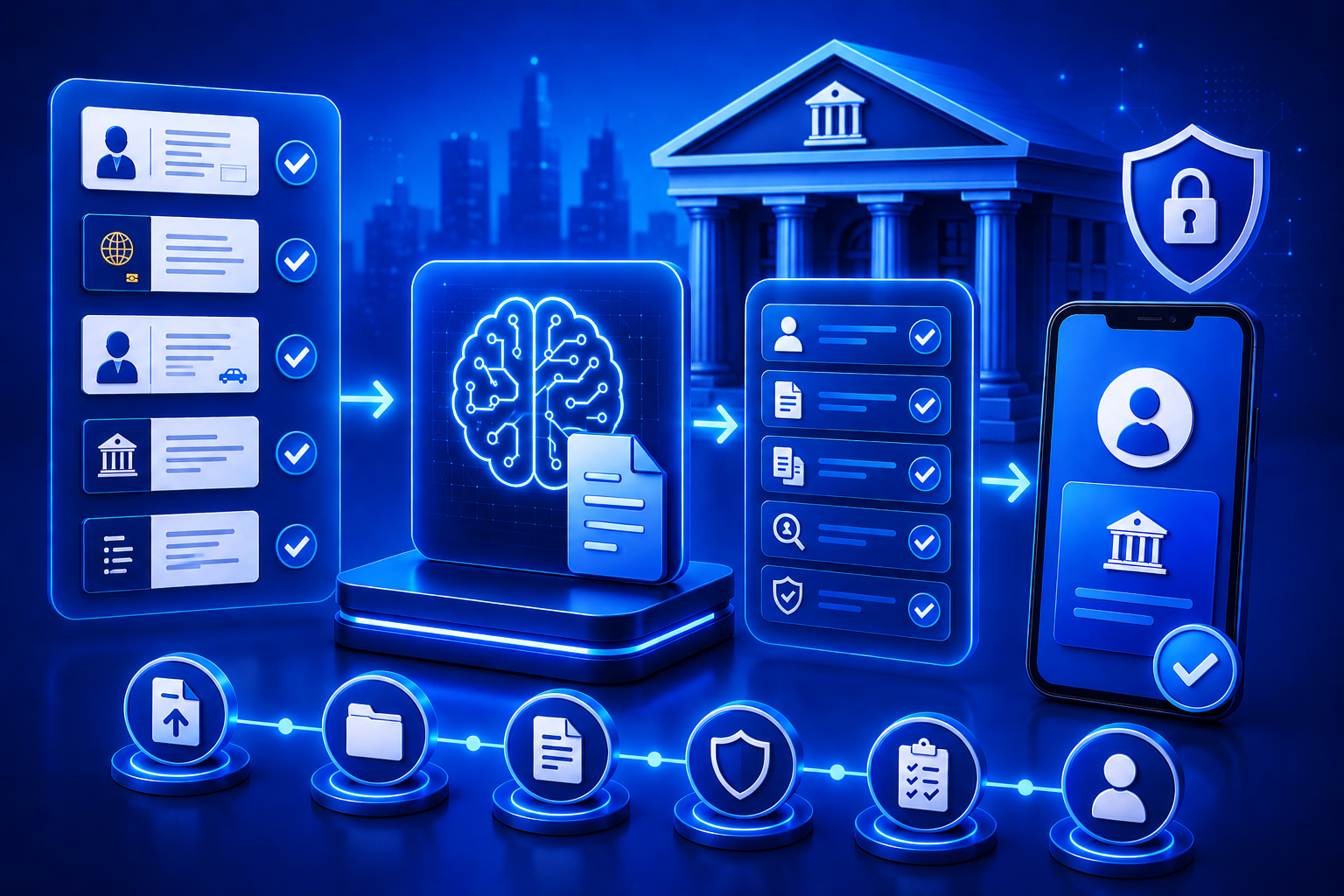
IDP is not a standalone solution. The full power of KYC automation comes from connecting IDP outputs to a workflow orchestration layer that sequences the entire onboarding journey.
A well-designed automated KYC workflow covers:
- Document collection: Digital intake channels that prompt customers for the right documents based on their customer type and product application.
- IDP extraction and validation: Automated extraction, classification, and cross-validation of all submitted documents.
- AML and sanctions screening: Automated submission of extracted identity data to AML and sanctions lists, with results fed back into the workflow.
- Risk scoring: Rule-based or ML-driven risk classification based on identity attributes, geography, business type, and transaction profile.
- Approval routing: Automatic approval for standard-risk profiles, escalation to compliance reviewers for elevated-risk or incomplete cases.
- Account provisioning: Automated triggering of account creation in core banking systems upon approval, with structured data passed via API.
For corporate KYC, the workflow extends to cover UBO verification, entity hierarchy mapping, and multi-signatory document collection – all orchestrated through the same platform.
Handling Exceptions with Agentic AI
Not every KYC case is clean. Documents arrive with fields obscured. Extracted names do not match exactly across documents. An applicant’s address on their ID differs from their utility bill. A corporate applicant has a beneficial owner in a high-risk jurisdiction.
Agentic AI handles this middle layer – cases that are too complex for pure rule-based routing but do not require full human review from scratch.
In KYC exception handling, Agentic AI can:
- Determine whether a name mismatch is a transliteration difference, a nickname, or a genuine identity discrepancy – and route accordingly.
- Request specific additional documents from the customer based on the specific gap identified, rather than sending a generic request for resubmission.
- Apply contextual risk logic to borderline cases – for example, a document that fails one validation check but passes five others may be cleared with a documented rationale rather than rejected.
- Escalate only the cases that genuinely require human judgment, with a structured case file that gives the reviewer everything they need to decide quickly.
The result is a compliance process that is faster, more consistent, and more defensible than a purely manual one – with human reviewers focused on genuinely complex cases.
The Aptimeta Approach to KYC Automation
Aptimeta provides a unified platform that covers the full KYC and onboarding stack – IDP for document processing, BPM and workflow orchestration for end-to-end process sequencing, RPA for system integrations where APIs are unavailable, and Agentic AI for exception handling and intelligent routing.
Financial institutions using Aptimeta do not need to integrate separate best-of-breed tools for each layer of the KYC process. The platform handles document ingestion, extraction, validation, workflow orchestration, AML integration, risk scoring, and audit trail generation within a single governed environment.
For retail banking and NBFC onboarding, this translates to significantly reduced time-to-account. For corporate KYC, it means complex, document-heavy cases are handled systematically rather than ad hoc. For compliance teams, it means every decision is logged, timestamped, and traceable – ready for regulatory review without manual reconstruction.