
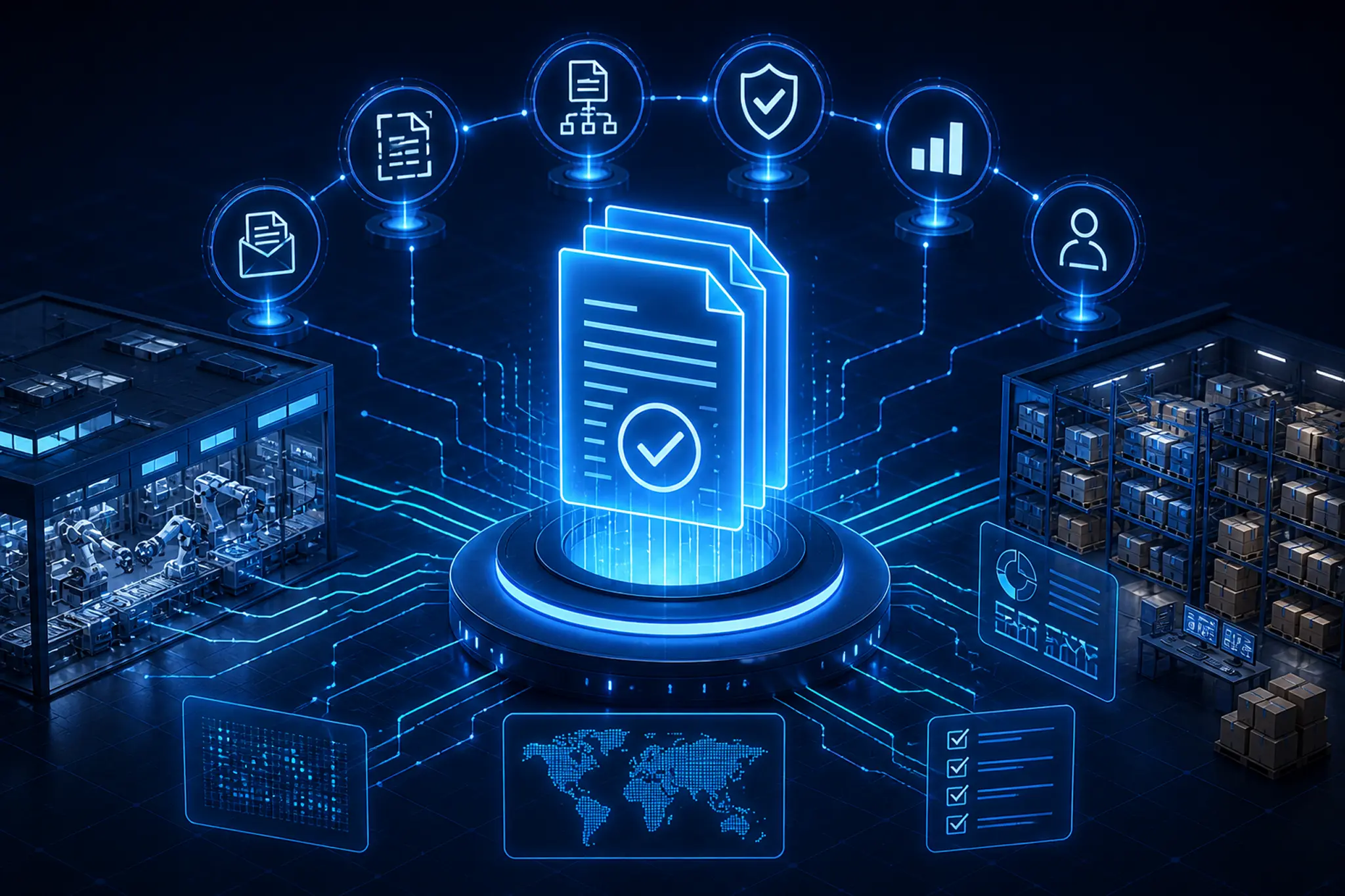
Supply chain visibility is often viewed as a technology challenge, but in reality it begins with documents. Every purchase order, supplier certificate, shipping document, invoice, and customs declaration contains information that drives procurement, inventory, logistics, and finance processes.
When these documents are processed manually, delays and errors become unavoidable. Information must be extracted, validated, entered into multiple business systems, and verified before work can continue.
Intelligent Document Processing (DocuBrain), together with Robotic Process Automation (RPA) and enterprise workflow orchestration, transforms supply chain documents into structured digital workflows that move automatically across procurement, logistics, compliance, and ERP systems.
The Documentation Challenge Across the Supply Chain
Modern supply chains depend on thousands of documents flowing between suppliers, manufacturers, logistics providers, and customers.
Purchase Orders
Purchase orders arrive through email attachments, supplier portals, PDFs, EDI transactions, and other document formats.
Every document must be classified, validated, and entered into procurement systems before purchasing activities can continue.
Supplier Onboarding
Before suppliers can transact, organisations must collect tax registrations, banking details, insurance certificates, quality certifications, regulatory documents, and compliance records.
Manual verification across multiple systems often delays supplier activation and procurement timelines.
Shipping and Compliance Documentation
Packing slips, bills of lading, shipping manifests, delivery confirmations, customs declarations, certificates of origin, and regulatory compliance documents accompany every shipment.
Each document must be matched with purchase orders, inventory records, and financial transactions while meeting international compliance requirements.
Why Manual Document Processing Slows Supply Chains
Manual document processing consumes valuable operational time while increasing the likelihood of data-entry errors.
Incorrect purchase order numbers, missing supplier information, incomplete customs documentation, or inaccurate inventory records create delays that ripple throughout procurement, production, logistics, and finance operations.
Many organisations attempt to solve these problems using traditional OCR technology.
However, OCR simply reads text. It cannot understand document context, validate business information, recognise changing layouts, or intelligently route documents through business workflows.
As a result, employees continue manually transferring information between procurement systems, ERP platforms, logistics applications, and supplier databases.
How Intelligent Document Automation Works
DocuBrain uses AI to classify incoming documents, understand their structure, extract relevant business information, and validate data against enterprise rules.
Supplier names, product numbers, delivery dates, quantities, pricing, payment terms, customs information, and compliance details are extracted automatically regardless of document format.
RPA then transfers validated information into procurement systems, ERP platforms, logistics applications, and supplier management solutions without manual data entry.
Workflow orchestration coordinates the complete document lifecycle, ensuring approvals, validations, compliance reviews, notifications, and downstream processes occur automatically.
Purchase Order Automation
Purchase orders received through email, supplier portals, EDI platforms, or PDF documents are automatically classified by DocuBrain.
The platform extracts supplier details, product codes, quantities, pricing, delivery schedules, and commercial terms before validating information against supplier master data and product catalogues.
RPA creates purchase orders within ERP and procurement systems while workflow orchestration manages acknowledgements, supplier notifications, approval workflows, and exception handling.
Incomplete or inconsistent purchase orders are routed to procurement teams together with complete contextual information, allowing rapid resolution instead of manual document processing from the beginning.
Automating Supplier and Shipping Documentation
Supplier onboarding documents, quality certifications, banking information, insurance certificates, customs declarations, shipping manifests, and delivery records are automatically captured and validated.
Business rules verify compliance requirements while workflow automation routes documentation to procurement, logistics, finance, or compliance teams as required.
This significantly reduces supplier onboarding time while improving shipment visibility and regulatory compliance.
Why a Unified Automation Platform Matters
Many organisations deploy separate solutions for document processing, workflow management, RPA, and ERP integration.
This fragmented approach often creates additional complexity.
Aptimeta combines Intelligent Document Processing, Robotic Process Automation, Business Process Automation, Agentic AI, and enterprise workflow orchestration within one intelligent automation platform.
Supply chain documents move seamlessly from capture to validation, ERP processing, compliance review, supplier communication, inventory updates, and financial processing without manual handoffs.
Operations teams gain complete visibility across the entire document lifecycle while exceptions are managed through intelligent workflows instead of disconnected systems.
Transform Supply Chain Operations with Aptimeta
By eliminating manual document processing, organisations accelerate procurement, improve supplier onboarding, strengthen compliance, reduce processing errors, and create a more resilient supply chain.