Enterprise automation has evolved rapidly over the past few years.
Many organisations began their automation journey with Robotic Process Automation (RPA) to eliminate repetitive work and improve operational efficiency. As business requirements became more complex, additional technologies were introduced to solve new challenges.
Intelligent Document Processing improved document extraction. Business Process Automation increased workflow visibility. Agentic AI introduced intelligent decision-making, while workflow orchestration connected systems and business processes.
Each technology delivered measurable value.
Processes became faster, manual effort decreased, and operations became increasingly scalable.
However, many enterprises eventually discovered that significant manual work still existed between systems, approvals, and automation platforms.
The challenge was not automation itself. The challenge was that automation capabilities had evolved faster than the connections between them.
This is why many organisations are now moving beyond isolated automation initiatives toward unified intelligent automation platforms.
How Enterprise Automation Reached This Point
Most automation programmes followed a similar path.
RPA delivered rapid improvements for repetitive tasks.
As automation expanded, organisations introduced Intelligent Document Processing, workflow management, AI, analytics, and orchestration to automate increasingly complex operations.
Each technology solved a specific business challenge exceptionally well.
Over time, however, enterprises began managing multiple automation platforms that operated independently.
Business data moved through custom integrations. Approvals required manual coordination. Visibility was spread across separate dashboards. Automation programmes were owned by different teams with different priorities.
The automation technologies themselves were not creating operational challenges.
The gaps between them were.
The Hidden Cost of Disconnected Automation
A process that is largely automated may still require manual intervention whenever information moves between systems.
Operations teams spend valuable time maintaining integrations instead of expanding automation capabilities.
Exceptions generated in one platform frequently require manual intervention across multiple downstream systems.
Leadership often lacks a complete view of end-to-end workflow performance because operational information is distributed across multiple applications.
Individually, these challenges appear manageable.
Together, they significantly reduce the business value organisations expect from enterprise automation.
Disconnected vs Unified Procure-to-Pay Automation
Procure-to-Pay clearly demonstrates the difference between isolated automation and unified intelligent automation.
In many organisations, requisitions are processed by one automation platform, approvals are managed elsewhere, invoices are extracted separately, and ERP updates rely on multiple disconnected integrations.
Each automation component performs well independently, yet manual coordination remains necessary throughout the overall workflow.
Within a unified automation platform, requisition processing, approval routing, purchase order creation, invoice capture, Intelligent Document Processing, AI validation, and ERP posting operate as one connected business process.
Information flows automatically across every stage without manual transfers or disconnected system handoffs.
The outcome is not simply faster execution.
It is a more resilient, scalable, and transparent enterprise operation.
What Unified Intelligent Automation Delivers
Connected Enterprise Data
Business information flows seamlessly across workflows without repeated uploads, manual transfers, or inconsistent data between systems.
Enterprise-Wide Visibility
Workflow orchestration provides a unified operational view across workflows, approvals, automation performance, exceptions, and business outcomes through one connected platform.
Faster Automation Expansion
New automation initiatives can be deployed more quickly because organisations no longer spend significant effort building integrations between disconnected automation platforms.
Greater Operational Consistency
Shared workflows and connected business data improve process accuracy, simplify exception handling, and standardise execution across departments.
Stronger Governance
Unified automation provides centralised governance, operational accountability, compliance monitoring, and enterprise-wide control over automation programmes.
A Practical Path Toward Unified Automation
The transition to unified automation typically happens in stages.
Organisations begin by assessing existing automation environments, identifying workflow dependencies, integration challenges, and areas where manual effort still exists.
New automation projects are then deployed on connected automation platforms while existing high-value workflows are gradually migrated into the unified environment.
As automation maturity increases, organisations simplify governance, reduce operational complexity, and accelerate enterprise-wide automation adoption.
Choosing the Right Automation Platform
A modern intelligent automation platform should provide:
- Native integration across RPA, Intelligent Document Processing, Business Process Automation, Agentic AI, and workflow orchestration.
- Centralised operational visibility across workflows and business processes.
- Connected workflow management without manual system handoffs.
- Shared enterprise data models that maintain consistency throughout every process.
- Scalable architecture that supports long-term business growth.
- Rapid deployment of future automation initiatives.
How Aptimeta Enables Unified Intelligent Automation
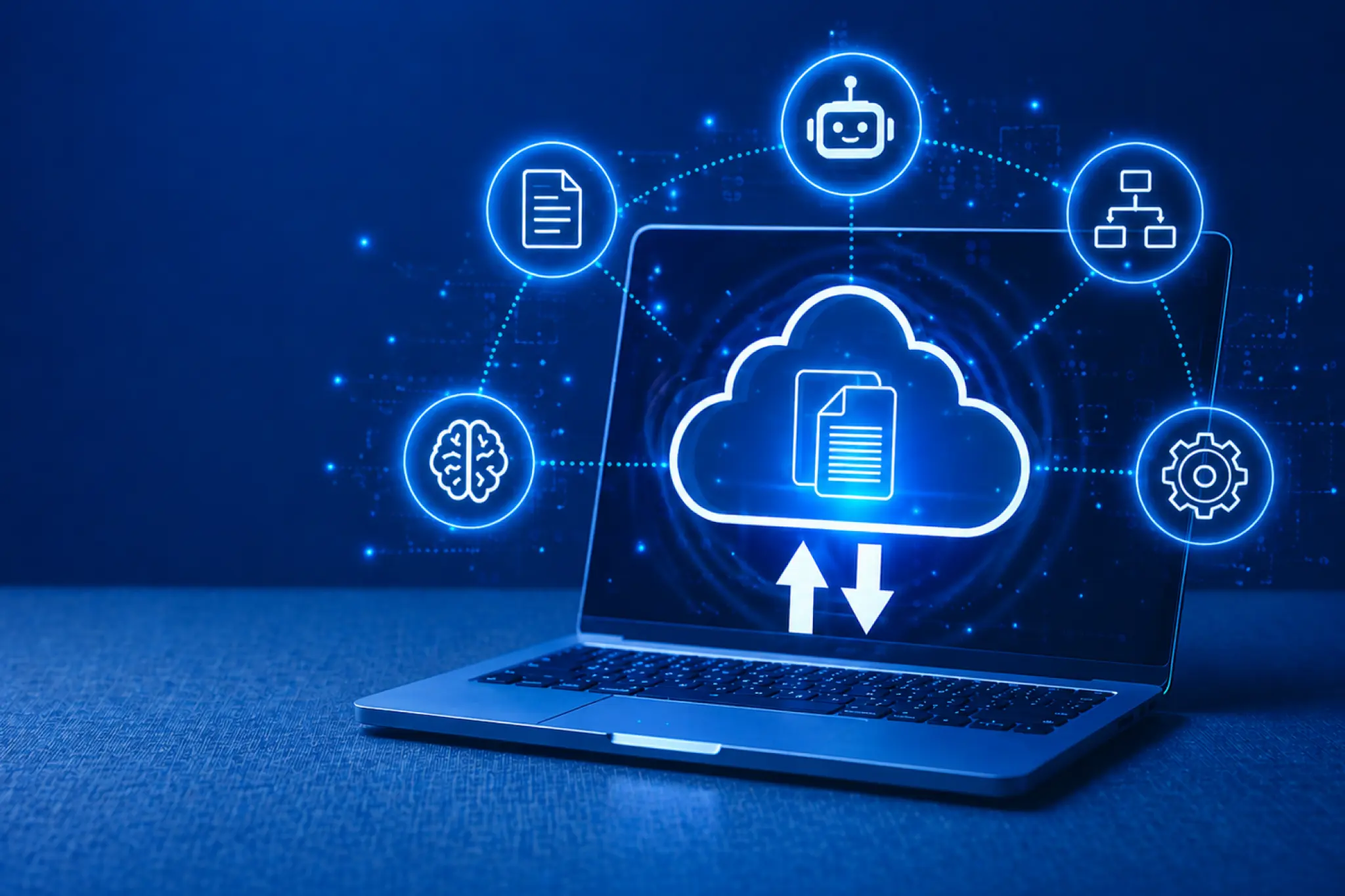
Aptimeta brings together Robotic Process Automation, Intelligent Document Processing, Business Process Automation, Agentic AI, and enterprise workflow orchestration within one intelligent automation platform.
Rather than managing disconnected automation tools, organisations gain one connected automation ecosystem where workflows, documents, AI, approvals, enterprise systems, and people operate together seamlessly.
This enables faster process execution, reduced integration complexity, improved governance, stronger operational visibility, and an automation foundation that scales alongside business growth.
Discover how Aptimeta helps organisations move beyond isolated automation projects to build unified intelligent automation ecosystems that connect workflows, AI, documents, and enterprise systems into one scalable platform.